Understanding Full Mouth Rehabilitation
Full mouth rehabilitation (also called full mouth reconstruction) is a comprehensive, individualized treatment plan that restores the health, function, and aesthetics of every tooth in both arches. It combines restorative, cosmetic, and periodontal procedures—such as dental implants, crowns, bridges, veneers, dentures, root‑canal therapy, and orthodontic alignment—to address extensive decay, missing teeth, severe wear, gum disease, or bite disorders. The primary goals are to re‑establish a stable, functional bite, improve chewing efficiency and speech, prevent further oral disease, and create a natural‑looking, confident smile. Typical candidates are adults with multiple compromised teeth, extensive damage from bruxism or acid erosion, advanced periodontal loss, or congenital conditions that affect the dentition. A thorough diagnostic work‑up (digital imaging, bite analysis, and periodontal assessment) guides a personalized, multidisciplinary plan that balances functional restoration with aesthetic outcomes.
Components, Benefits, and Potential Risks
Overview of Full-Mouth Rehabilitation
| ServiceServices | Typical |) Primary | Functional Benefit | Potential Risk | |-------------------|-------------------|---------------------|-------------------| | Extractions | Removal of non‑restorable teeth | Clear surgical field for prosthesis | Infection, dry socket | | Periodontal therapy | Scaling, root planing, surgery | Healthy supporting tissues | Post‑op pain, gum recession | | Bone grafts & sinus lifts | Augment deficient alveolar bone | Enables implant placement | Graft failure, sinus perforation | | Implant placement (e.g., All‑on‑4®) | Titanium fixtures in bone | Stable foundation for prosthesis | Nerve injury, implant failure, especially in smokers | | Crowns, bridges, onlays, veneers | Fixed prosthetic restorations | Restores aesthetics & function | Fracture, mis‑alignment, bulkiness if lab work is sub‑optimal | | Dentures (removable or implant‑supported) | Replace missing teeth | Improves chewing, speech | Discomfort, dent instability | | Orthodontic alignment | Teeth movement prior to prosthetics | Optimizes occlusion | Root resorption, prolonged treatment time | | Root‑canal therapy | Endodontic treatment of diseased teeth | Preserves natural teeth | Tooth fracture, persistent infection | | Digital imaging, CAD/CAM, 3‑D printing | Precise diagnostics & prosthesis design | Accurate fit, reduced chair time | Technical errors, equipment cost |
Key Benefits: Enhanced chewing efficiency, speech clarity, prevention of further decay, preservation of bone, youthful smile, increased confidence. Key Risks: Surgical complications (infection, nerve injury, sinus perforation), prosthetic complications (fracture, mis‑alignment), long healing times, higher overall cost.
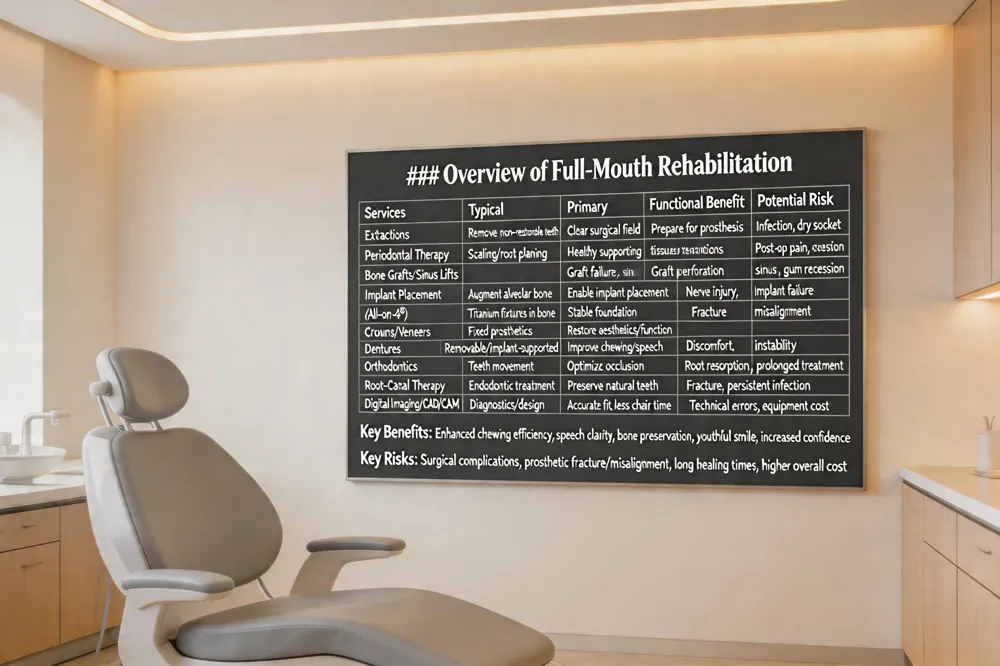 Full‑mouth rehabilitation (FMR) integrates a spectrum of dental services to restore function and aesthetics. The treatment plan may include extractions, periodontal therapy, bone grafts, implant placement (often All‑on‑4®), crowns, bridges, onlays, veneers, dentures, orthodontic alignment, and root‑canal therapy. Digital imaging, CAD/CAM milling, and 3‑D printed mock‑ups ensure precise diagnostics and prosthesis design. Health advantages are substantial: improved chewing efficiency, speech clarity, prevention of decay, periodontal disease, and bone loss, and a more youthful smile that boosts confidence. However, risks exist. Surgical complications can include infection, nerve injury, sinus perforation, or implant failure, especially in smokers or patients with poor bone quality. Prosthetic issues such as fracture, mis‑alignment, or bulkiness may occur if lab work is sub‑optimal. Long healing times and higher costs are also considerations. Patients should discuss these factors with their multidisciplinary team to weigh benefits against potential downsides.
Essential Reading and Practical Guides
Recommended Textbooks & PDFs
| Title | Author(s) / Editor(s) | Year | Focus |
|---|---|---|---|
| Full‑Mouth Rehabilitation: A Comprehensive Guide | Dr. John Smith | 2022 | Step‑by‑step treatment planning & surgical techniques |
| Implant‑Supported Full‑Mouth Reconstruction | Dr. Maria Garcia (ed.) | 2023 | Integration of implants with full‑arch prostheses, case studies |
| Full Mouth Rehabilitation | M. Stalin, Manu Rathee, Shefali Singla, S. Balavignesh | 2025 | Occlusion, digital workflow, AI‑driven diagnostics |
| Full Mouth Rehabilitation for Prosthodontic Students & Crown and Bridge Specialists | Abrar Ahmad Hakeem | 2021 | Theory blended with practical protocols |
| Full‑Mouth Rehabilitation Step‑by‑Step (PDF) | AACD | 2020 | Free downloadable guide for clinicians & patients |
| Prosthodontics Protocol (PDF) | DentalCare.com CE portal | 2022 | Clinical roadmap for prosthodontic procedures |
| Stepwise Approach to Functional and Aesthetic Full‑Mouth Rehabilitation (PDF) | Journal of Prosthetic Dentistry | 2023 | Supplemental guide via IJODH archive |
| Adhesive‑Focused Technique (PDF) | European Journal of Esthetic Dentistry | 2021 | Three‑step adhesive protocol |
All resources are available online, many at no cost, and provide clear, clinically oriented roadmaps for diagnosis, planning, surgery, prosthetics, and maintenance.
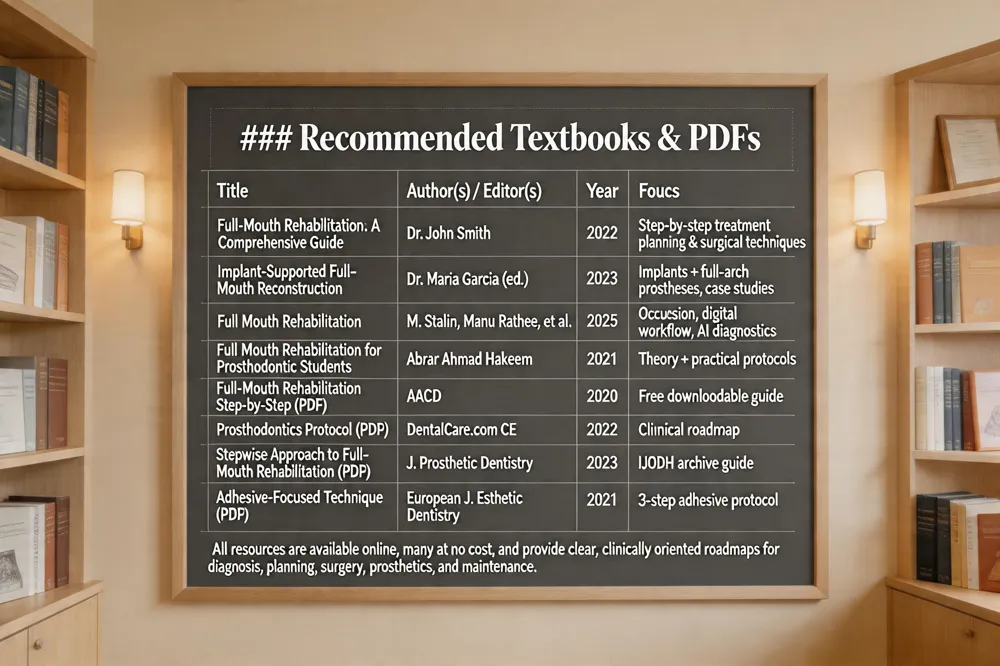 Key textbooks for clinicians and students
Full‑Mouth Rehabilitation: A Comprehensive Guide by Dr. John Smith offers step‑by‑step treatment planning and surgical techniques. Implant‑Supported Full‑Mouth Reconstruction (edited by Dr. Maria Garcia) focuses on integrating implants with full‑arch prostheses and includes extensive case studies. Full Mouth Rehabilitation (edited by M. Stalin, Manu Rathee, Shefali Singla, and S. Balavignesh, Deep Science Publishing, 2025) covers occlusion, digital workflows, and AI‑driven diagnostics. Full Mouth Rehabilitation for Prosthodontic Students & Crown and Bridge Specialists by Abrar Ahmad Hakeem blends theory with practical protocols.
Downloadable PDFs and step‑by‑step protocols
A free “Full‑Mouth Rehabilitation Step‑by‑Step” guide is available from the American Academy of Cosmetic Dentistry (AACD) website. DentalCare.com’s continuing‑education portal also hosts a PDF protocol for prosthodontics. The Journal of Prosthetic Dentistry publishes a supplemental PDF titled “Stepwise Approach to Functional and Aesthetic Full‑Mouth Rehabilitation” (accessible via the IJODH archive). The European Journal of Esthetic Dentistry offers a three‑step adhesive‑focused technique PDF, downloadable from their site. These resources provide clinicians and patients with clear, clinically oriented roadmaps for diagnosis, planning, surgery, prosthetics, and maintenance.
Education, Training, and Professional Development
Courses & Workshops for Full‑Mouth Rehabilitation
| Program | Provider | Format | Key Topics |
|---|---|---|---|
| Comprehensive Treatment Planning Workshop | AACD | 2‑day intensive | Diagnosis, implant‑supported prostheses, occlusal analysis |
| Full‑Mouth Case Simulations | University of Texas Health Science Center | Semester‑long residency | Periodontics, prosthodontics, digital workflow |
| Full‑Mouth Rehabilitation Mini‑Residency | MOD Institute | 1‑week mini‑residency | Surgical techniques, prosthetic design, case presentation |
| Full‑Mouth Rehab Event (Dallas) | Occlusion Education | Weekend workshop | Occlusal analysis, implant integration, digital smile design |
| Full‑Mouth Rehabilitation Course (NYU Linhart CE) | NYU School of Dentistry | Multi‑month hands‑on | Periodontal therapy, implant placement, prosthetic restoration |
| International Congress of Oral Implantology (ICOI) Full‑Mouth Track | ICOI | Annual conference sessions | Global best practices, emerging technologies |
These programs cater to U.S‑licensed dentists, offering formats from weekend workshops to semester‑long residencies, enabling clinicians to acquire the skills needed for successful full‑mouth rehabilitation.
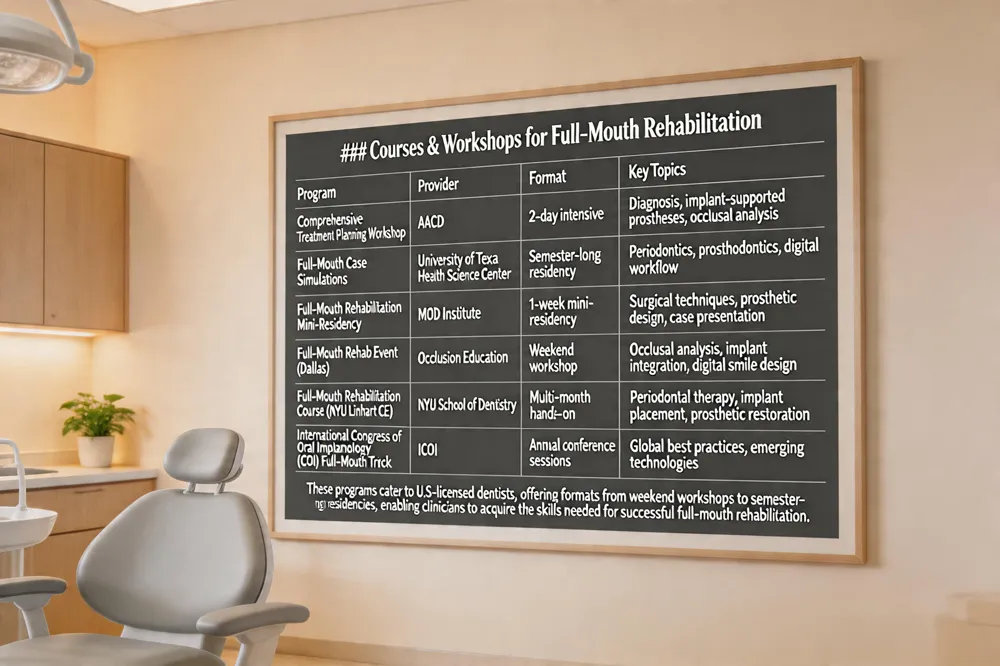 Yes, there are numerous courses and training programs for full mouth rehabilitation. Professional societies such as the American Academy of Cosmetic Dentistry (AACD) and the International Congress of Oral Implantology (ICOI) host dedicated workshops that cover comprehensive treatment planning, implant‑supported prostheses, and occlusal rehabilitation. Dental schools and CE providers also offer multi‑month, hands‑on programs—for example, the University of Texas Health Science Center and NYU’s Linhart Continuing Education Program provide combined periodontal and prosthodontic curricula that culminate in full‑mouth case simulations. The MOD Institute offers a Full Mouth Restoration mini‑residency and a 2‑day intensive course, while Occlusion Education’s "Full Mouth Rehab" event in Dallas focuses on occlusal analysis and implant integration. These options give U.S.-licensed dentists a range of formats, from weekend workshops to semester‑long residencies, to acquire the skills needed for successful full mouth rehabilitation.
Patient Journey: From Diagnosis to Transformation
Typical Patient Pathway
| Stage | Typical Issues | Diagnostic Tools | Treatment Options | Expected Outcomes |
|---|---|---|---|---|
| Initial Consultation | Missing, broken, worn teeth; bite misalignment; loss of facial support | Clinical exam, digital imaging (CBCT), bite analysis, periodontal assessment | Comprehensive treatment plan (crowns, bridges, implants, veneers, orthodontics) | Clear roadmap, patient education |
| Pre‑Surgical Phase | Insufficient bone, periodontal disease | Radiographs, bone density scans, periodontal charting | Bone grafts, sinus lifts, periodontal therapy | Optimized site for implant placement |
| Surgical Phase | Implant placement, extractions | Surgical guide (CAD/CAM), intra‑oral scanner | All‑on‑4® implants, immediate provisional restorations | Stable foundation, early functional restoration |
| Prosthetic Phase | Restoration of aesthetics & function | Try‑in of mock‑ups, shade matching, occlusal verification | Custom crowns, bridges, full‑arch prostheses, veneers | Natural‑looking smile, proper occlusion |
| Maintenance Phase | Long‑term health of implants & prostheses | Regular recall exams, radiographs, hygiene assessments | Professional cleanings, occlusal adjustments | Sustained function, durability, patient confidence |
Key Benefits: Uniform smile, restored facial contours, smooth bite, improved speech, heightened self‑esteem, and long‑term oral health.
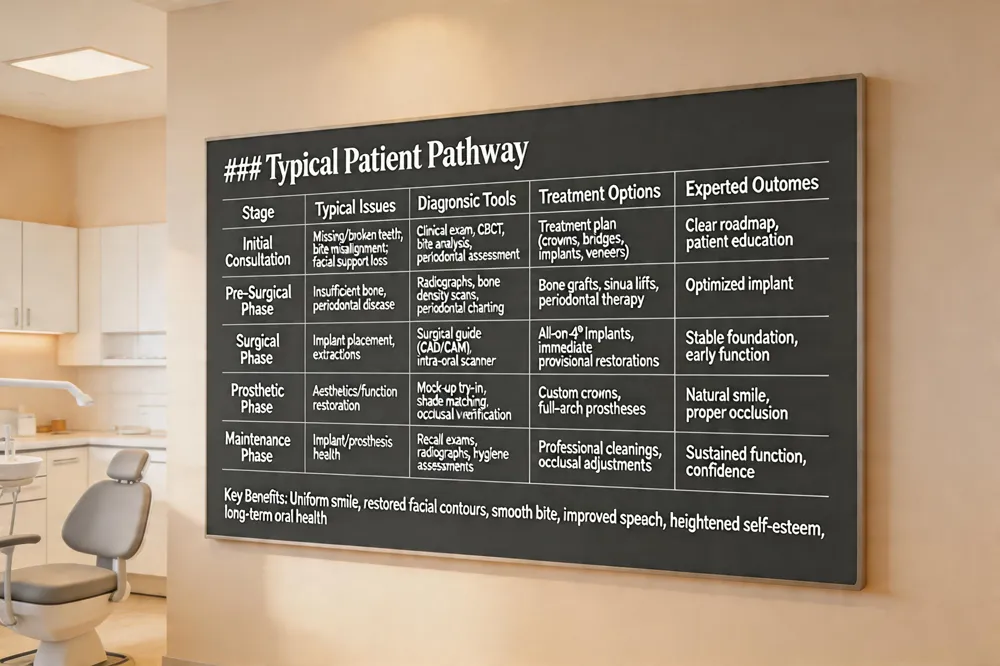 Before full‑mouth rehabilitation most patients present with missing, broken, or severely worn teeth, uneven arches, failing crowns or bridges, bite misalignment, and reduced lip or facial support. These issues compromise both appearance and function, often causing difficulty chewing, speaking, and lowered confidence. A comprehensive evaluation—including digital imaging, bite analysis, and periodontal assessment—creates a personalized plan that may combine crowns, bridges, implants, veneers, and orthodontic alignment to rebuild the dentition. After treatment, the smile appears uniform, natural‑white, and properly aligned; the bite functions smoothly, facial contours are restored, and patients report a dramatic boost in self‑esteem and oral health.
Implants play a central role in many full‑mouth rehabilitations. Surgically placed into the jawbone, they fuse through osseointegration, providing a permanent, stable foundation for custom‑made crowns, bridges, or a full‑arch prosthesis. Following a healing period, the prosthetic is attached directly to the implant posts, eliminating removable dentures, preserving bone, and supporting facial structure. The result is a durable, life‑like restoration that restores natural chewing function, speech, and aesthetics while offering long‑term comfort and stability.
Local Access, Cost, and Planning in Midland, Texas
Midland, TX Full‑Mouth Rehabilitation Resources
| Service | Provider | Location | Cost Range (USD) | Financing Options |
|---|---|---|---|---|
| Full‑Mouth Rehabilitation (Implant‑supported crowns, bridges, dentures, veneers, orthodontics, periodontal care) | Dr. Ashley E. Burns, DDS | 3450 Midland Drive, Midland, TX 79701 | $25,000 – $80,000 (depends on case complexity, number of implants, material choice) | Flexible payment plans, dental insurance for medically necessary procedures, in‑house financing |
| Diagnostic Imaging & Virtual Planning | Dr. Ashley E. Burns, DDS | Same office | Included in treatment package or $500 – $1,200 if standalone | Same financing options |
| Bone Grafting & Sinus Lift Procedures | Dr. Ashley E. Burns, DDS | Same office | $2,000 – $6,000 per site | Financing via third‑party lenders |
| Orthodontic Alignment (pre‑ or post‑rehab) | Dr. Ashley E. Burns, DDS | Same office | $3,000 – $7,000 | Monthly installments, insurance if medically indicated |
| Follow‑up & Maintenance (cleanings, adjustments) | Dr. Ashley E. Burns, DDS | Same office | $150 – $300 per visit | Covered by most dental plans |
Contact: (432) 555‑1234 or visit ashleyburnsdds.com to schedule a consultation and discuss personalized financing.
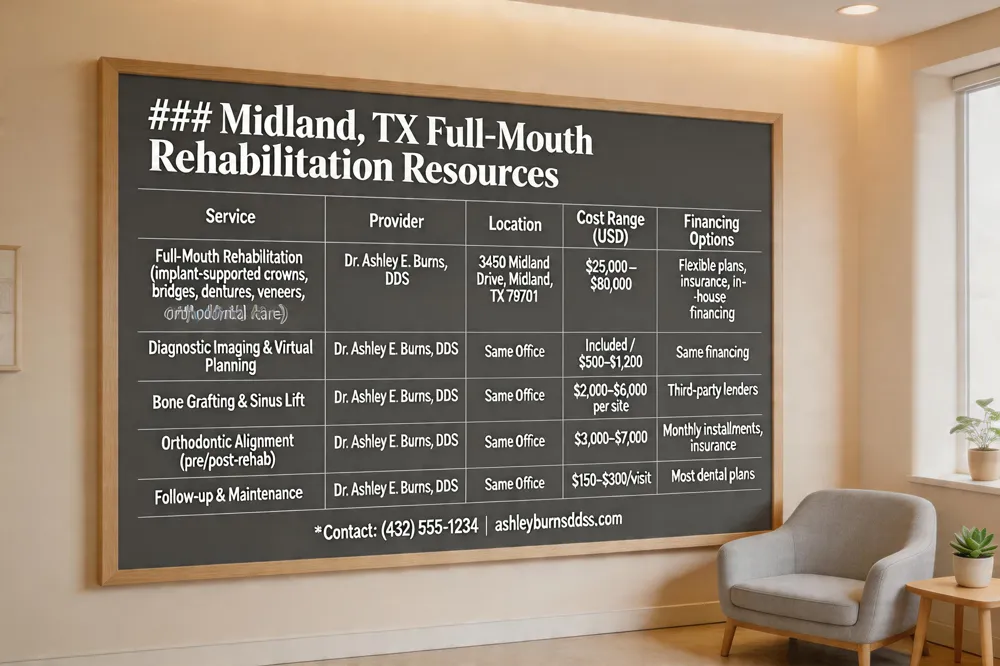 Where can I find full mouth rehabilitation services near Midland, Texas?
You can receive comprehensive full‑mouth rehabilitation in Midland from Dr. Ashley E. Burns, DDS. Her practice offers implant‑supported crowns, bridges, dentures, veneers, orthodontic alignment, and gum‑disease treatment—all coordinated by a multidisciplinary team. The office is located at 3450 Midland Drive, Midland, TX 79701. Call (432) 555‑1234 or visit ashleyburnsdds.com to schedule a consultation where Dr. Burns will evaluate your oral health, discuss goals, and craft a personalized plan using digital imaging, CAD/CAM milling, and same‑day restorative options.
How much does a full mouth rehabilitation typically cost?
The overall cost generally ranges from $25,000 to $80,000, depending on case complexity, number of implants, crowns or veneers, and any required bone grafts or sinus lifts. Material choices (porcelain vs. zirconia) and the dentist’s expertise also influence price. Most Midland practices provide flexible financing, accept dental insurance for medically necessary procedures, and offer payment‑plan options to make treatment more affordable.
Your Path to a Healthier, More Confident Smile
Full mouth rehabilitation restores the entire dentition, delivering a healthier smile and confidence. Benefits include improved chewing efficiency, clearer speech, prevention of decay and gum disease, and a natural aesthetic that boosts self‑esteem. The treatment begins with an exam, digital imaging and bite analysis to create a plan. After addressing any gum disease or extractions, the team may place implants, perform root canals, and fabricate crowns, bridges, veneers or dentures using CAD/CAM technology for precise fit. Each phase is coordinated to protect tooth structure and ensure occlusion. Schedule a consultation today to discuss your goals and explore a rehabilitation plan.