Introduction
Implant longevity is a cornerstone of modern restorative dentistry. Across decades of research, five‑year survival rates hover around 92‑95 % and ten‑year rates exceed 95 %, with many studies reporting 96 % to 99 % survival when optimal conditions are met. These numbers reflect not only the biocompatibility of titanium but also the cumulative impact of surgical precision, bone quality, prosthetic design, and rigorous post‑operative care. Evidence‑based practice—leveraging systematic reviews, long‑term cohort data, and controlled trials—allows clinicians to identify risk factors such as smoking, uncontrolled diabetes, and parafunctional habits, and to adopt protocols (delayed placement, platform‑switching, guided surgery) that consistently improve outcomes. By grounding treatment plans in robust data, dentists can set realistic expectations and enhance the predictability of implant success for patients worldwide.
Survival Rates Over Decades
Implant Survival Over Time
| Follow‑up Period | Reported Survival Rate | Key Source |
|---|---|---|
| 10 years (large cohort) | 95 %–96 % (≈ 96.4 % CI 95.2–97.5 %) | Systematic review (PMID: 30904559) |
| 10 years (sensitivity) | 93.2 % (CI 90.1–95.8 %) | Same review, sensitivity analysis |
| 20 years (meta‑analysis) | 70 %–85 % (retrospective ≈ 88 %, prospective ≈ 92 %) | Multiple meta‑analyses |
| 30 years (very long‑term) | ≈ 70 % | Long‑term follow‑up studies |
| Overall definition | Implant remains in situ, irrespective of bone loss or symptoms | — |
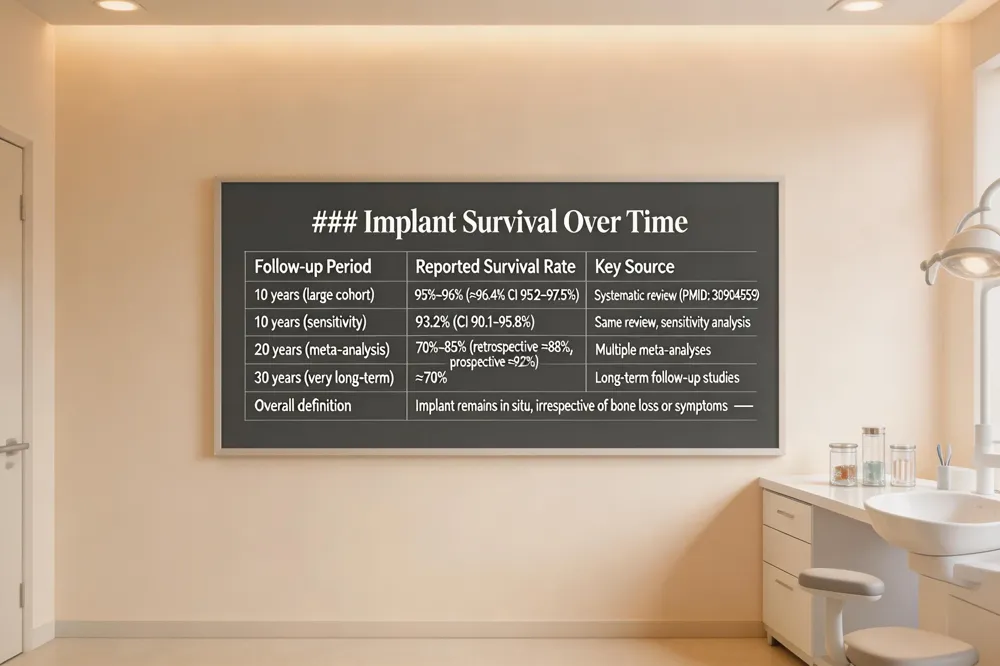 Dental implant success rate after 10 years: Large cohort and systematic‑review data show a ten‑year survival of roughly 95 %–96 % for modern rough‑surface titanium implants. One review reported 96.4 % (95 % CI 95.2–97.5 %) and a sensitivity analysis 93.2 % (95 % CI 90.1–95.8 %).
Long‑term (10‑year) systematic review and sensitivity meta‑analysis: The traditional estimate was 96.4 % with a prediction interval of 91.5–99.4 %; the sensitivity model lowered survival to 93.2 % and broadened the interval to 76.6–100 %, highlighting modestly higher risk in older patients (≥65 yr).
Dental implant success rate after 20 years: Meta‑analyses indicate 70 %–85 % survival at two decades, with retrospective data near 88 % and prospective data around 92 % (some protocols, e.g., All‑on‑4, exceed 90 %).
Dental implant success rate after 30 years: Very long‑term follow‑ups suggest about 70 % of implants remain functional after three decades, with most failures occurring in the first ten years.
Implant survival definition: Survival simply means the implant remains in situ and has not been removed, regardless of bone loss or symptoms; it is expressed as the proportion of implants still present at a given follow‑up period.
Patient‑Related Risk Factors and Downsides
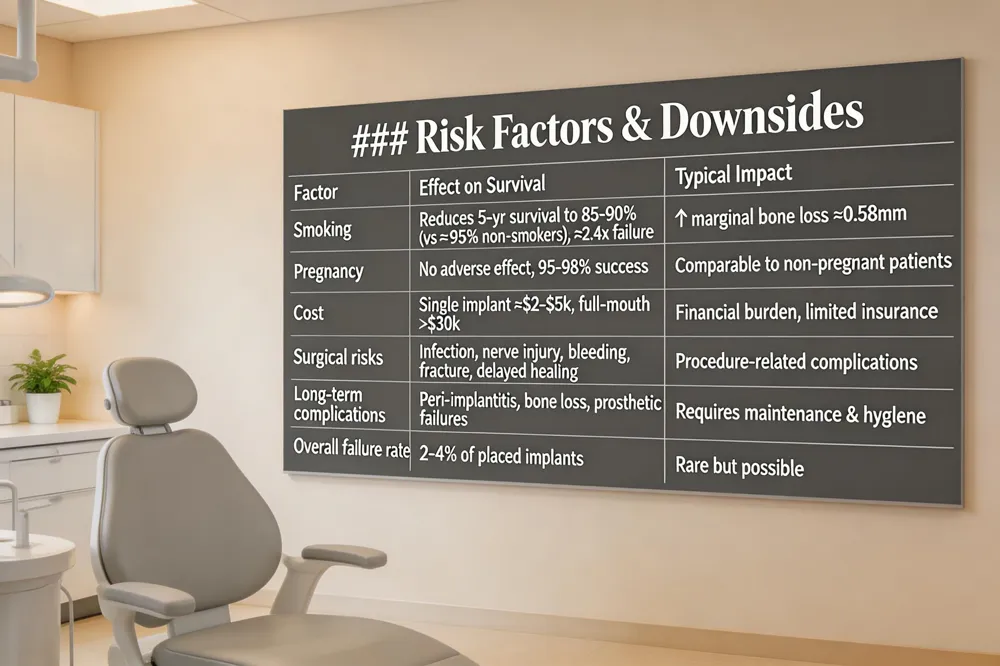
Risk Factors & Downsides
| Factor | Effect on Survival | Typical Impact |
|---|---|---|
| Smoking | Reduces 5‑yr survival to 85‑90 % (vs ≈ 95 % for non‑smokers); OR ≈ 2.4 for failure | ↑ marginal bone loss ≈ 0.58 mm |
| Pregnancy | No adverse effect; 95‑98 % success | Comparable to non‑pregnant patients |
| Cost | Primary downside; single implant ≈ $2‑$5 k, full‑mouth > $30 k | Financial burden, limited insurance |
| Surgical risks | Infection, nerve injury, bleeding, fracture, delayed healing | Procedure‑related complications |
| Long‑term complications | Peri‑implantitis, bone loss, prosthetic failures | Requires maintenance & hygiene |
| Overall failure rate | 2‑4 % of placed implants | Rare but possible |
 Dental implant success rate for smokers
Smokers experience a lower 5‑year survival (≈ 85‑90 %) versus non‑smokers (≈ 95 %). Meta‑analyses show smoking roughly doubles the odds of failure (OR ≈ 2.4) and increases early‑failure risk 2‑3‑fold, especially in the maxilla. Marginal bone loss is about 0.58 mm greater in smokers. Cessation before surgery restores success rates close to non‑smokers.
Dental implant success rate for smokers
Smokers experience a lower 5‑year survival (≈ 85‑90 %) versus non‑smokers (≈ 95 %). Meta‑analyses show smoking roughly doubles the odds of failure (OR ≈ 2.4) and increases early‑failure risk 2‑3‑fold, especially in the maxilla. Marginal bone loss is about 0.58 mm greater in smokers. Cessation before surgery restores success rates close to non‑smokers.
What is the downside of getting a tooth implant? Cost is the primary downside; a single implant can cost several thousand dollars, and full‑mouth reconstructions may exceed tens of thousands, often with limited insurance coverage. Surgical risks include infection, nerve injury, bleeding, jaw fracture, and delayed bone healing. Even after successful placement, crowns may need replacement, adding further expense.
Implant success rate pregnancy Pregnancy does not adversely affect osseointegration. Success rates in pregnant women remain 95‑98 %, comparable to non‑pregnant patients. Hormonal changes have minimal impact on bone healing, so long‑term stability is unchanged.
Which is healthier: root canal or implant? Root‑canal therapy preserves the natural tooth, maintains bone, and avoids surgery, making it the conservative choice when the tooth is structurally sound. Implants replace the tooth entirely and help preserve jawbone density in severely compromised cases but involve surgery, higher cost, and longer healing. The healthier option depends on individual dental condition and medical history.
Which is more painful: root canal or implant? Root canals can cause immediate discomfort during pulp removal, while implant surgery feels like a sore bruise after anesthesia wears off. Both procedures are well‑controlled with local anesthesia and OTC analgesics; pain perception varies by individual threshold.
How common is it for a dental implant to fail? Implant failure is rare, occurring in about 2‑4 % of placed implants (2‑4 failures per 100 implants).
Can a dental implant cause problems years later? Yes. Late‑onset peri‑implantitis, bone loss, or prosthetic complications can arise, especially with poor oral hygiene, smoking, or uncontrolled diabetes. Regular professional cleanings and vigilant home care are essential to maintain implant health for decades.
Surgical Techniques and Prosthetic Design
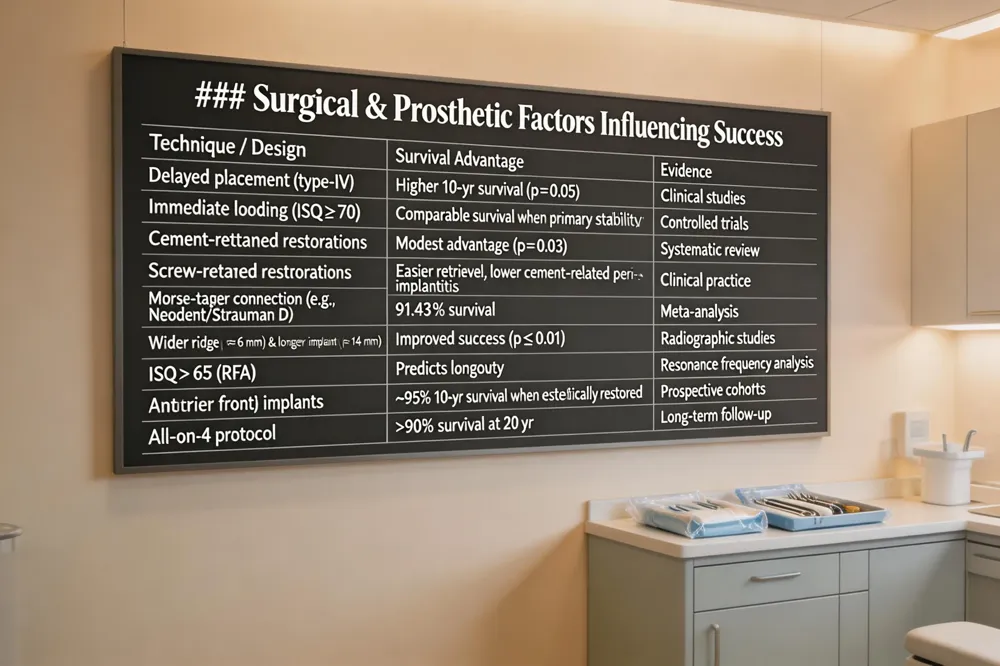
Surgical & Prosthetic Factors Influencing Success
| Technique / Design | Survival Advantage | Evidence |
|---|---|---|
| Delayed placement (type IV) | Higher 10‑yr survival (p = 0.05) | Clinical studies |
| Immediate loading (ISQ ≥ 70) | Comparable survival when primary stability achieved | Controlled trials |
| Cement‑retained restorations | Modest advantage (p = 0.03) | Systematic review |
| Screw‑retained restorations | Easier retrieval, lower cement‑related peri‑implantitis | Clinical practice |
| Morse‑taper connection (e.g., Neodent/Straumann D) | 91.43 % survival | Meta‑analysis |
| Wider ridge (≈ 6 mm) & longer implant (≈ 14 mm) | Improved success (p ≤ 0.01) | Radiographic studies |
| ISQ > 65 (RFA) | Predicts longevity | Resonance frequency analysis |
| Anterior (front) implants | ~95 % 10‑yr survival when esthetically restored | Prospective cohorts |
| All‑on‑4 protocol | >90 % survival at 20 yr | Long‑term follow‑up |
 Implant success criteria are defined by clinical stability (no mobility, pain, infection) and radiographic health (≤1.5 mm bone loss in year first year, ≤0.2 mm annually thereafter). Soft‑tissue health—no bleeding on probing, healthy gingival architecture—and functional, esthetic prosthetics complete the definition.
Immediate versus delayed placement: delayed (type IV) placement consistently show higher survival (p = 0.05) because the surgical site has time for bone remodeling, whereas immediate loading requires high primary stability (ISQ ≥ 70) and controlled occlusion.
Cement‑retained restorations versus screw‑retained restorations: cemented crowns demonstrate a modest survival advantage (p = 0.03), but screw‑retained designs simplify retrieval and reduce cement‑related peri‑implantitis risk.
Morse‑taper connections (e.g., Neodent/Straumann system D) yield the best outcomes, with a 91.43 % survival rate, likely due to micro‑gap minimization and improved load distribution.
Bone dimensions and stability: larger ridge width (≈6 mm) and length (≈14 mm) correlate with higher success (p ≤ 0.01). Resonance frequency analysis values >65 ISQ further predict longevity.
Front tooth implants: anterior implants achieve ~95 % ten‑year survival when placed in adequate bone and restored with esthetic prostheses, mirroring posterior success rates.
All‑on‑4 protocol: long‑term data show >90 % implant survival at 20 years, provided rigid splinting, proper occlusion, and diligent maintenance.
Regular professional clean‑ups, optimal oral hygiene, and control of systemic factors (diabetes, smoking) remain essential across all techniques.
Maintenance, Oral Hygiene, and Lifestyle
Maintenance & Lifestyle Recommendations
| Practice | Frequency | Expected Benefit |
|---|---|---|
| 3‑3‑3 rule (brush 3×/day, 3 min, replace brush every 3 mo) | Daily | Superior plaque control vs. 2×/day |
| Soft‑bristled brush (45° angle) | Every brushing | Minimizes gingival trauma |
| Floss/ interdental cleaning | Daily | Reduces peri‑implant mucositis |
| Professional cleaning | Twice a year | Early detection of peri‑implant disease |
| Balanced diet (calcium, vitamin D, protein, antioxidants) | Ongoing | Supports bone health & osseointegration |
| Smoking cessation | Prior to surgery & ongoing | ↓ failure risk 3‑fold |
| Diabetes control (HbA1c < 7 %) | Ongoing | Improves healing & long‑term survival |
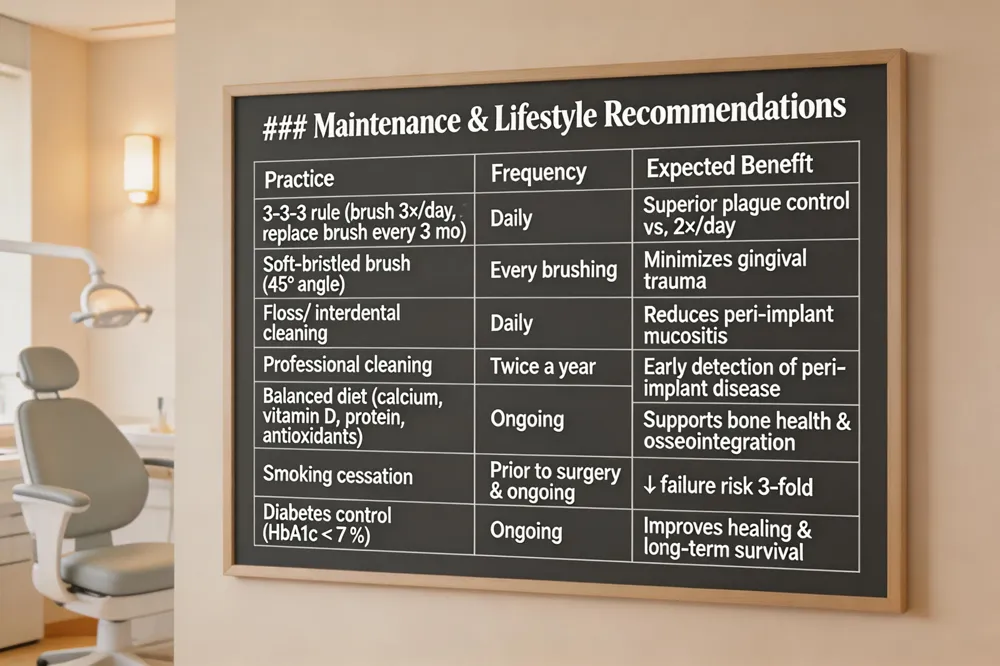 Maintaining dental implants hinges on a disciplined oral‑care routine and healthy habits. The 3‑3‑3 rule—brush three times a day for three minutes each session and replace the toothbrush every three months—provides a proactive upgrade over the minimum twice‑daily, two‑minute recommendation. Soft‑bristled brushes held at a 45° angle, gentle pressure, and daily flossing or interdental cleaning keep plaque away from the implant‑abutment interface.
Professional cleanings twice a year enable clinicians to detect early peri‑implant mucositis, perform implant‑safe scaling, and monitor probing depths and bleeding on probing, both strong predictors of long‑term survival.
A balanced diet rich in calcium, vitamin D, protein, and antioxidants supports bone health and osseointegration; adequate hydration aids natural cleansing. Smoking cessation dramatically lowers failure risk—studies show a three‑fold increase in smokers—while tight diabetes control (HbA1c < 7 %) mitigates impaired healing.
Preventing peri‑implantitis relies on meticulous oral hygiene, regular maintenance visits, and avoiding hard or sticky foods during early healing. When these measures are followed, implants demonstrate excellent long‑term safety: patient‑level success exceeds 97 % at three years, remains above 86 % at fifteen years, and many implants function for 25‑30 years or a lifetime. In contrast, typical dental restorations—composite fillings (5‑7 years), ceramic crowns (10‑15 years), and bridges (5‑8 years)—require more frequent replacement. A well‑maintained implant can therefore outlast most conventional restorations, offering a durable, reliable solution for decades.
Future Outlook and Patient Guidance
Long‑Term Outlook & Patient Guidance
| Recommendation | Rationale |
|---|---|
| Lifelong monitoring (brush, floss, antibacterial rinse) | Controls plaque, early disease detection |
| Semi‑annual professional visits | Radiographic & clinical assessment of bone & soft tissue |
| Use Morse‑taper, platform‑switching implants | Minimize micro‑gap, protect crestal bone |
| Ensure primary stability (torque ≥ 35 N·cm or ISQ ≥ 65) | Reduces early failure risk |
| Guided surgery for precise placement | Improves alignment, reduces complications |
| Maintain systemic health (smoking cessation, diabetes control) | Enhances osseointegration & long‑term survival |
| Expect functional lifespan of 25‑40 + years with proper care | Evidence from 40‑year cohort studies |
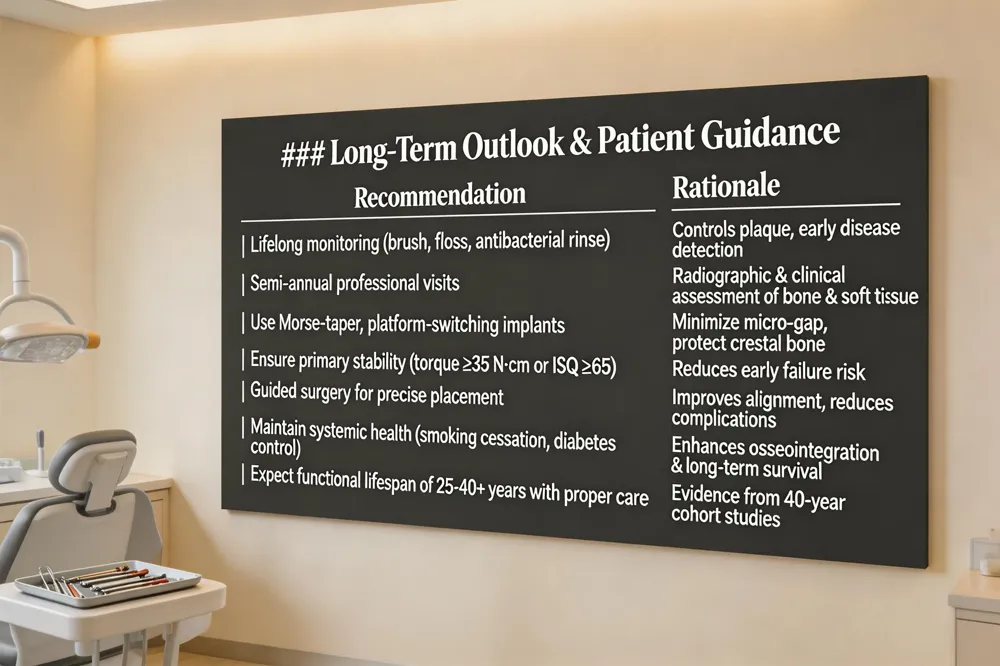 Long‑term data suggest that implants can function for 40 years or more. In a University of Gothenburg cohort, implants evaluated after nearly four decades remained fully functional and in situ, underscoring the durability of modern titanium systems when proper care is observed.
Patient education should emphasize lifelong monitoring: daily brushing with a soft‑bristled toothbrush, flossing or interdental cleaning, and use of an antibacterial rinse help control plaque. Regular radiographic and clinical assessments—probing depth, bleeding on probing, and marginal bone levels—allow early detection of complications. Clinicians should advise patients to schedule maintenance visits at least twice a year, adjust the prosthesis as needed, and replace worn restorations promptly.
Clinical recommendations for sustained success include selecting a biocompatible implant system (e.g., Morse‑taper connection), ensuring primary stability (insertion torque ≥35 N·cm or ISQ ≥65), employing guided surgery for precise placement, and using platform‑switching abutments to protect crestal bone. By integrating these evidence‑based strategies with consistent patient adherence, implants can remain a reliable solution for 25, 40, or even more years.
Conclusion
Successful dental implants result from a combination of optimal patient health, precise surgical technique, and diligent long‑term maintenance. Adequate bone volume and quality, controlled systemic conditions (e.g., diabetes, hypertension), non‑smoking status, and absence of parafunctional habits such as bruxism dramatically improve survival. Delayed placement protocols, high primary stability (≥35 N·cm torque or ISQ > 60), Morse‑taper connections, and proper prosthetic design (platform‑switching, cement‑retained when appropriate) further enhance outcomes. Equally critical are daily oral hygiene, regular professional cleanings, balanced nutrition, and prompt reporting of any discomfort.
We invite patients to schedule a comprehensive evaluation, discuss personalized risk‑reduction strategies, and commit to a lifelong maintenance program to secure the lasting health and function of their implant restorations.