Introducing Immediate Loading Implants
Immediate loading implants—often called “same‑day” or “teeth in a day” implants—are placed and restored within 48‑72 hours of surgery. The protocol relies on achieving high primary stability (insertion torque ≥ 35 N·cm or ISQ > 65) so that a provisional crown can be attached immediately, while osseointegration proceeds under functional load.
Patient‑centered benefits include a dramatically shortened treatment timeline, elimination of a visible tooth‑less interval, and fewer surgical visits. Patients enjoy instant functional and aesthetic restoration, which improves confidence, speech, and nutrition. The one‑stage approach also preserves alveolar bone and soft‑tissue architecture, reduces postoperative discomfort, and can lower overall costs by avoiding temporary prostheses and additional appointments.
Why Dr. Ashley Burns offers this option in Midland, Texas – Midland’s growing population and active lifestyle demand efficient, high‑quality dental care. Dr. Burns utilizes 3‑D cone‑beam CT imaging, computer‑guided surgical guides, and implant systems such as NobelActive that provide the primary stability required for immediate loading. Her practice tailors case selection to each patient’s bone quality, systemic health, and aesthetic goals, ensuring that the convenience of same‑day restoration is delivered with predictable long‑term success. This combination of advanced technology, evidence‑based protocols, and personalized care makes immediate loading implants an ideal choice for Midland residents seeking rapid, durable smile rehabilitation.
Understanding Immediate Loading Protocols
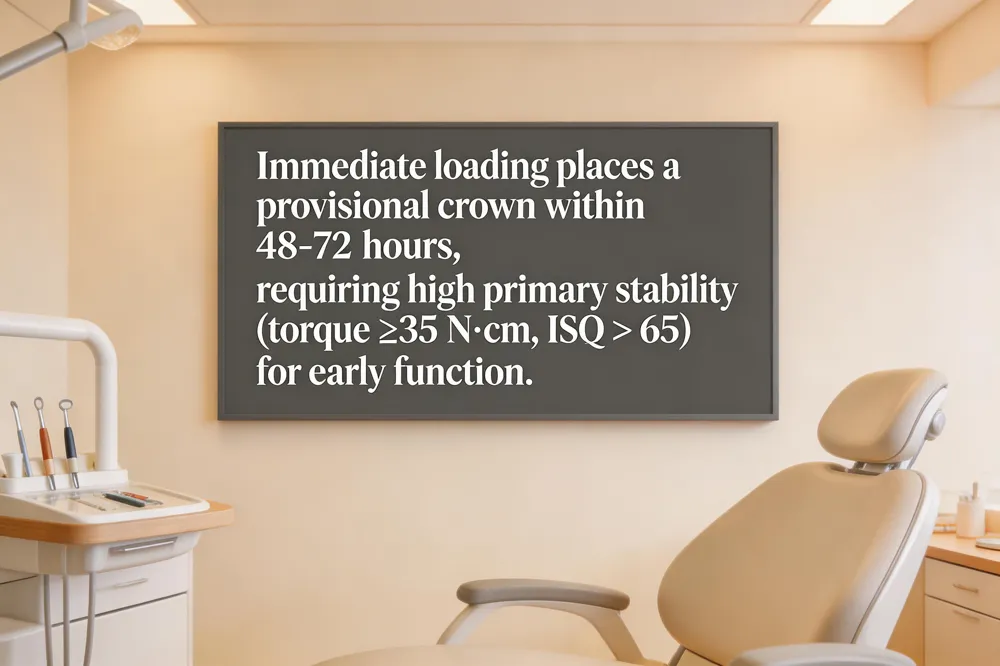 What is the immediate implant loading protocol?
Immediate loading means that a provisional or definitive crown is placed and brought into functional occlusion within 48 – 72 hours of implant insertion. The protocol hinges on achieving high primary stability—typically an insertion torque of ≥ 35 N·cm or an ISQ > 65—so the implant can tolerate early functional forces. Candidates must be systemically healthy, have adequate bone volume and density, and be free of acute infection or uncontrolled periodontal disease. The restoration is usually screw‑retained, fabricated chair‑side or in a lab, and adjusted to avoid excessive occlusal loading while allowing normal mastication.
Primary stability requirements
Primary stability is the mechanical lock between implant and bone at placement. It is assessed by torque values, resonance‑frequency analysis (ISQ), and bone‑quality classification (e.g., D2/D3). Techniques such as undersized drilling, bicortical fixation, and the use of tapered, rough‑surface implants (e.g., NobelActive) enhance stability, especially in the anterior mandible where bone density is high.
Provisional restoration fabrication and adjustment
A provisional crown is milled from acrylic or composite, designed to be slightly out of heavyclusion or to have reduced occlusal contacts. It is cemented or screwed onto the implant, then refined intra‑orally to ensure proper fit, soft‑tissue health, and patient comfort. Follow‑up visits monitor mobility, soft‑tissue response, and marginal bone levels, allowing early intervention if micromovement exceeds 150 µm.
Advantages and disadvantages of immediate loading implants
Advantages include same‑day aesthetics, reduced treatment time, fewer surgical visits, and higher patient satisfaction. Disadvantages involve a higher technical demand, the need for optimal bone quality, and a modestly increased risk of early failure or prosthetic complications if primary stability is insufficient. Careful case selection and diligent post‑operative care are essential for success. For a broader view of benefits and considerations, see the discussion on immediate‑loading outcomes here.
Implant Placement Timing Options
 Implant placement can be performed immediately at the time of tooth extraction when the socket walls are intact, there is at least 1 mm of facial bone, and primary stability can be achieved (insertion torque ≥ 30‑40 N·cm or ISQ > 65). Early placement (4–16 weeks after extraction) allows soft‑tissue healing and partial bone regeneration before implant insertion, making it suitable when modest bone remodeling is needed. Delayed or late placement (≥6 months) is chosen for extensive ridge resorption, major grafting, or when the site requires full bone maturation. Factors influencing timing include bone quality and quantity (Misch Class I‑IV), systemic health, smoking, bruxism, and aesthetic demands, especially in the anterior maxilla. Proper case selection ensures adequate primary stability, minimizes marginal bone loss, and leads to high long‑term survival rates (92‑98 %).
Advantages of Same‑Day Implants
 Same‑day (immediate‑load) dental implants offer several patient‑ and practice‑focused benefits. By achieving high primary stability, the clinician can place a provisional crown within 24‑48 hours, eliminating the need for multiple surgical visits and temporary dentures. This rapid restoration provides instant aesthetics and function, boosting patient confidence and allowing normal chewing and speech immediately. Economically, fewer appointments reduce overall clinic costs and can lower the total price for patients, especially when digital planning and guided surgery streamline the workflow. Immediate loading also helps preserve alveolar bone and soft‑tissue contours by stimulating the surrounding bone early, reducing the ridge resorption that typically follows tooth loss.
What are the advantages and disadvantages of immediate loading implants? Immediate‑load implants let patients leave the office with a fully restored smile in a single visit, dramatically cutting treatment time and reducing surgical appointments. They provide instant aesthetics and function, boosting confidence and oral health. However, they demand precise technique, sufficient bone density, and excellent primary stability; inadequate cases risk higher implant failure, infection, or fracture, and not all patients are suitable candidates.
What are the differences between immediate load dental implants and conventional implants? Conventional implants require a 3‑6‑month healing period before the permanent restoration, involving multiple visits and a temporary aesthetic gap. Immediate‑load implants receive a provisional restoration within 24 hours to a week, demanding high primary stability and meticulous planning but offering faster functional and aesthetic outcomes. Both protocols can achieve high long‑term success when proper case selection and post‑operative care are followed.
Potential Drawbacks and Risks
 Immediate loading implants, while offering rapid aesthetic and functional benefits, present several notable drawbacks.
Micromovement and osseointegration jeopardy – Successful immediate loading relies on high primary stability; micromovements exceeding 150 µm at the bone‑implant interface can disrupt osseointegration and raise early‑failure rates. Even micromovements between 50 µm and 150 µm may stimulate bone remodeling but can also increase marginal bone loss when occlusal forces are excessive.
Technical complexity and case‑selection limits – The protocol demands precise surgical technique, accurate torque (≥30–40 N·cm) or ISQ (>65), and often guided‑surgery tools. Consequently, it is limited to patients with good bone density (e.g., D2‑D3, anterior mandible) and excludes those with severe bone loss, uncontrolled systemic disease, or parafunctional habits.
Infection, bone loss, prosthetic complications – Immediate functional load can heighten infection risk, especially if the extraction site is not fully debrided. Slightly greater marginal bone loss in the first year (0.2–1 mm) has been reported, and prosthetic issues such as screw loosening or crown fracture may arise, requiring additional visits.
Overall, immediate loading yields comparable long‑term survival to delayed loading when case selection is meticulous, but its technical demands and potential for early complications make delayed protocols a safer default for higher‑risk patients.
Evidence from Systematic Reviews
 A recent systematic review of 69 studies evaluated nine placement‑loading combinations for partially edentulous patients. Weighted cumulative survival rates were uniformly high, ranging from 96 % to 100 %. Immediate placement with immediate loading (Type 1A) achieved a 98.4 % survival rate, while early placement with early loading (Type 2‑3B) reached 100 %. Conventional loading after early or late placement also performed comparably (96 %–98 %). The authors classified protocols 11C,Type2‑ typeC3 Type 4B and and 4C as scientifically and clinically validated (SCV), whereas Type 1A, Type 1B and Type 4A were documented clinically (CD). Thus, both timing of placement and loading protocol matter, but successful outcomes hinge on achieving primary stability.
Immediate loading implants demonstrate success rates of approximately 92 %–100 % in the literature, matching or exceeding conventional delayed‑loading results. High primary stability, adequate bone density, and careful case selection are the key determinants of these outcomes, confirming immediate loading as a reliable option for suitable patients.
Cost Overview for Immediate Implants
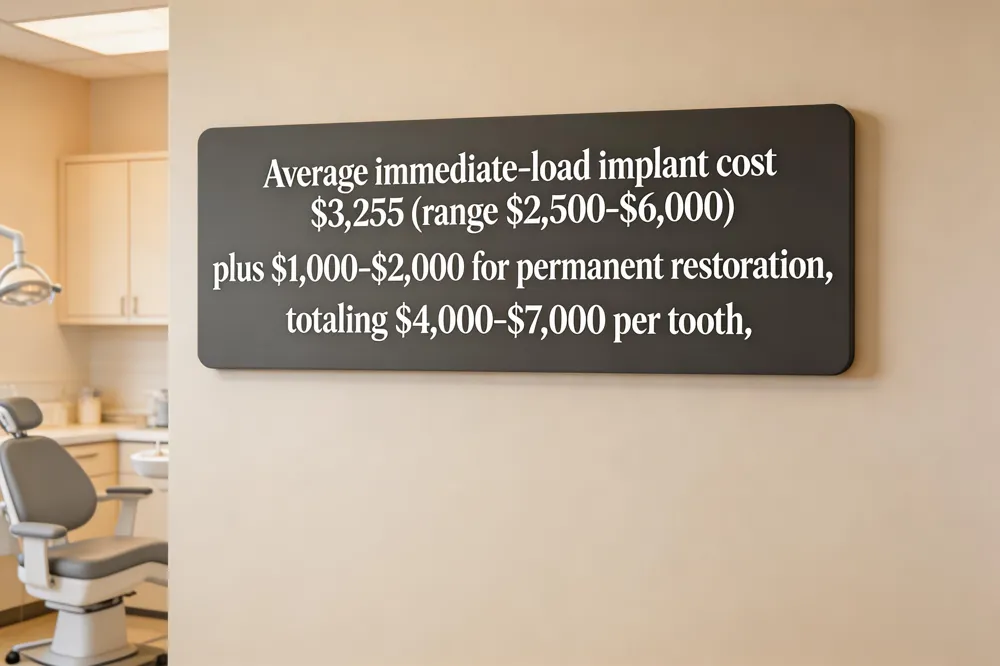 Immediate (same‑day) dental implants streamline treatment but carry a distinct price structure. The national average for a single immediate‑load implant is about $3,255, with typical fees ranging from $2,500 to $6,000 per tooth; this includes the titanium post, abutment and a temporary crown placed within 48‑72 hours. A permanent restoration adds roughly $1,000‑$2,000, so patients should budget $4,000‑$7,000 per implant for the complete sequence.
In Texas, a full‑mouth restoration for both arches runs between $30,000 and $70,000. All‑on‑4 protocols can start near $30,000, while more extensive All‑on‑6 or traditional full‑arch plans may approach $60,000‑$70,000. Costs fluctuate with the number of implants, need for bone grafts, prosthetic material (acrylic versus zirconia), laboratory and anesthesia fees. Screwless implants are priced similarly to screw‑retained options, generally $3,000‑$5,000 per unit in the state.
Financing plans, CareCredit, and health‑savings accounts help patients manage these upfront expenses, and dental insurance may cover ancillary procedures such as extractions or grafts, though the implant itself is usually elective.
Comparing Immediate and Delayed Loading
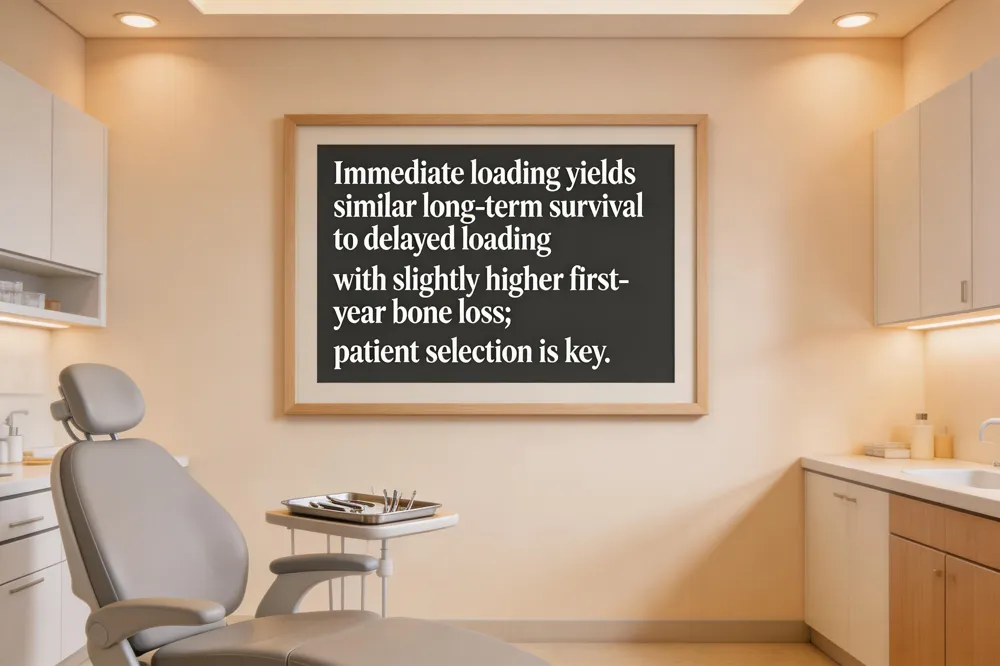 Immediate loading (IL) places a provisional prosthesis within 48‑72 hours, while delayed (conventional) loading (DL) waits 2‑6 months. Studies show IL and DL achieve 92‑98 % implant survival in single‑tooth cases, with systematic reviews reporting 97‑100 % over 5‑10 years. First‑year marginal bone loss is slightly greater for IL (≈0.2‑1 mm) versus DL (≈0.1‑0.8 mm), but the difference is not statistically significant. Ideal IL candidates have good bone density (D2‑D3), adequate volume, healthy soft tissue, and can reach insertion torque ≥30 N·cm or ISQ > 65; delayed loading is preferred when bone quality is poor, systemic health is compromised, or primary stability is uncertain. Long‑term outcomes for both protocols are comparable with proper case selection. How does immediate loading compare to delayed loading of dental implants? Immediate loading gives same‑day aesthetics and fewer visits, with survival similar to delayed loading when primary stability is achieved; delayed loading adds safety for higher‑risk sites. What is the success rate of immediate loading implants? Success ranges from 92 % to 100 % in well‑selected cases, matching conventional protocols for modern practice.
Alternatives to Implants and Insurance Considerations
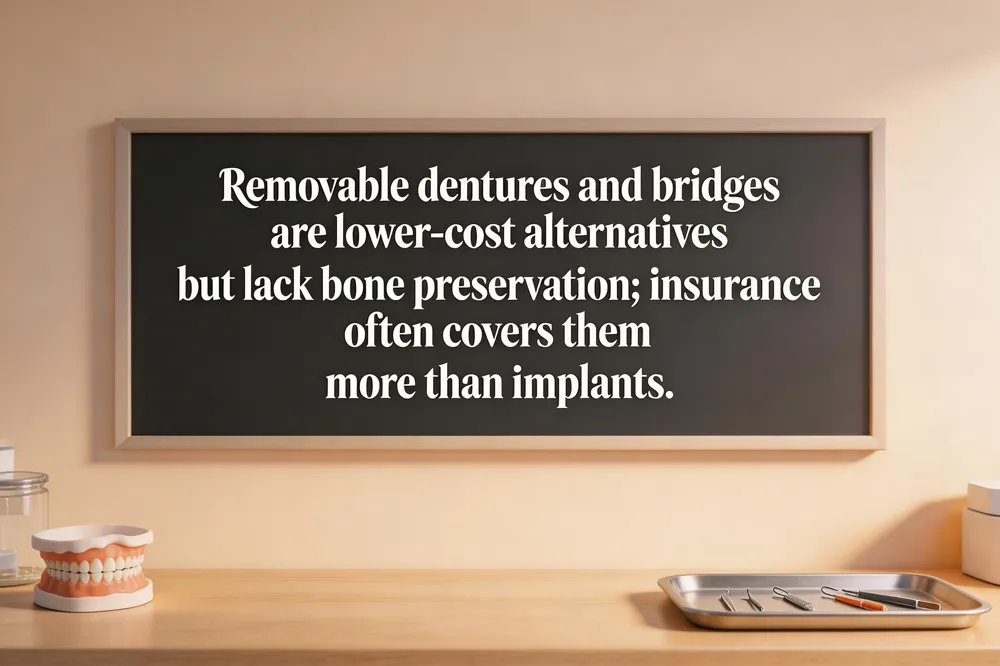 Removable dentures and bridges remain the most common non‑implant solutions for missing teeth. A full‑arch denture can be fabricated for a fraction of the $3,000‑$6,000 per‑implant cost, while a partial denture or a fixed bridge (using adjacent teeth as anchors) typically runs $500‑$2,500 per unit. These options avoid surgery and are generally completed in a few appointments, making them attractive for patients with limited budget or compromised bone. However, dentures do not preserve alveolar bone and may require periodic relining, and bridges involve preparation of healthy teeth, which can affect long‑term tooth health. Insurance coverage for dentures varies widely; many dental plans impose a 6‑ to 12‑month waiting period before covering major prosthetic work, and some offer no‑waiting‑period options at higher premiums. In contrast, most insurance plans treat implant placement as an elective procedure, providing little to no coverage for the implant, abutment, or crown. Therefore, while removable dentures and bridges are cheaper upfront, patients should weigh the lower initial expense against the need for ongoing maintenance and the limited preservation of jawbone density.
Clinical Guidelines, Technology and Practice Benefits
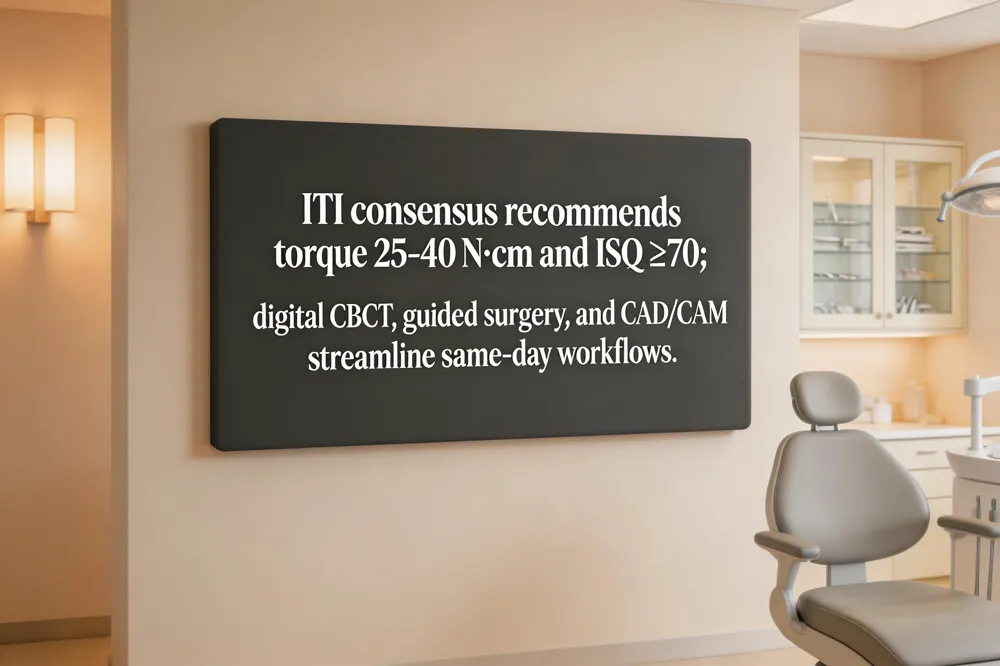 Immediate loading protocols rely on consensus criteria to achieve predictable outcomes. The International Team for Implantology (ITI) consensus advises insertion torque of 25‑40 N·cm (preferably >35 N·cm) and an ISQ of ≥70 before functional loading, especially in fresh extraction sockets. These parameters ensure primary stability minimizing micromovement and protecting osseointegration.
Digital workflow underpins same‑day implants in Dr. Ashley Burns’s Midland practice. A pre‑operative CBCT scan maps bone volume and density, while computer‑guided guides translate the virtual plan into osteotomy preparation. CAD/CAM then fabricates a provisional crown that fits the implant within 24‑48 hours, often out of occlusion to reduce early load. This integration shortens treatment time, reduces chair‑time, and enhances accuracy.
Economically, immediate loading reduces visits and eliminates the need for a temporary denture, lowering overall fees. For Dr. Burns, offering “Teeth in a Day” differentiates the practice, attracts time‑conscious patients, and creates a marketing narrative that highlights rapid aesthetics, patient comfort, and long‑term implant survival.
Putting It All Together
Immediate loading dental implants deliver a functional and aesthetic restoration within 24‑48 hours, dramatically shortening treatment time, reducing the number of clinical visits, and preserving bone and soft‑tissue architecture. Patients enjoy instant confidence, faster return to normal chewing, and lower overall costs when the protocol succeeds. The approach works best for individuals in Midland who have good overall health, adequate bone density (especially in the anterior mandible or maxilla), thick facial bone walls, and no uncontrolled systemic conditions. Candidates should be non‑smokers or willing to quit, have healthy gums, and exhibit acceptable bite forces. When these criteria are met, same‑day implants can be safely placed and loaded, delivering the “Teeth in a Day” experience that aligns with the community’s demand for efficient, high‑quality dental care. To determine if immediate loading is right for you, schedule a personalized consultation with Dr. Ashley E. Burns, DDS. Using 3‑D CBCT imaging, digital planning, and proven implant systems, Dr. Burns will assess your bone quality, discuss treatment options, and create a tailored plan that maximizes success and satisfaction.