Welcome to Dental Implant Excellence
Implant restoration begins with a thorough consultation and 3‑D imaging to evaluate bone volume and health. If needed, bone grafting or sinus lift is performed before the titanium post is surgically placed under local anesthesia. After a 2‑to‑month healing phase, the implant fuses with bone (osseointegration) and an abutment is attached. Custom crowns, bridges or dentures are then fabricated and secured, completing the smile. Long‑term care is essential because plaque and peri‑implantitis can jeopardize bone support, leading to failure. Daily brushing with a soft‑bristled brush, flossing or water‑flossing, and antimicrobial rinses keep the area clean, while regular six‑month check‑ups allow early detection of complications. Patients can expect a soft‑food diet immediately after surgery, gradual return to normal foods, and a clear maintenance plan that supports a lifetime of function and aesthetics for optimal oral health.
Pre‑Implant Considerations and Expectations
Quick‑Reference Table
| Topic | Key Point |
|---|---|
| Healing timeline | Full implant journey can take several months; patience is essential. |
| Discomfort | Usually less than expected; modern techniques make recovery routine. |
| Bone health | Early evaluation critical; grafts may be required. |
| Cost vs durability | Up‑front cost high, but long‑term durability makes implants cost‑effective. |
| Daily care | Brush twice daily, floss twice daily, routine check‑ups keep implants healthy. |
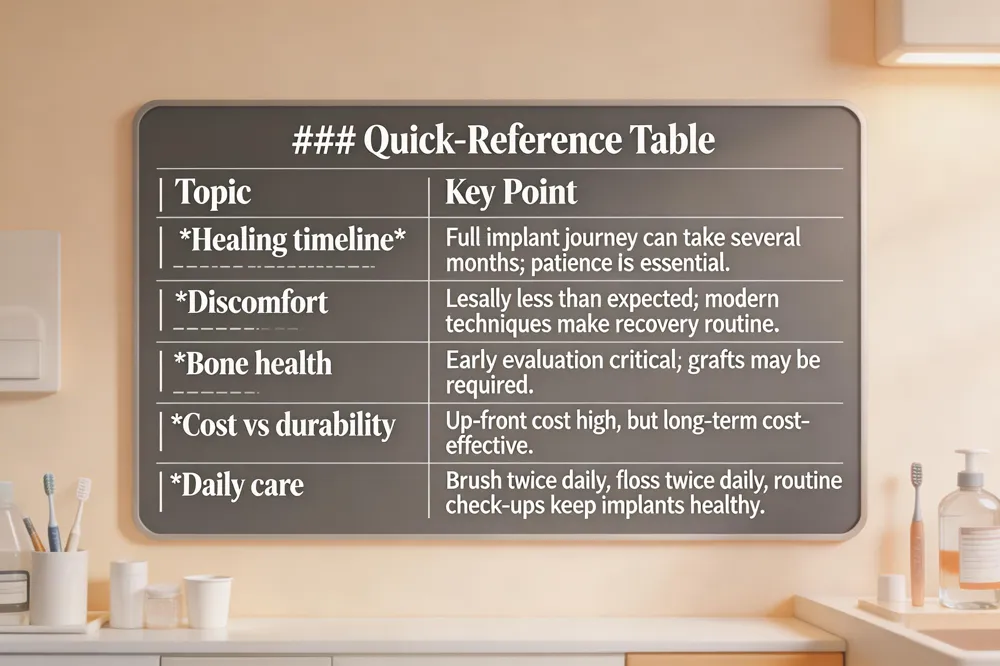 What I wish I knew before dental implants? One of the biggest surprises is how long the entire implant journey takes—healing and bone integration can span several months, so patience is essential. Discomfort is usually far less than expected, and modern techniques make recovery feel routine. Early evaluation of bone health is crucial; grafts may be needed. Although the upfront cost appears high, the durability and reduced need for replacements make implants a cost‑effective investment. Simple daily care—Brush twice daily, Floss twice daily, routine check‑ups—keeps them healthy.
Types of dental implants and cost. Endosteal implants are the most common, ranging from $1,500‑$3,500 per unit. Subperiosteal implants cost $2,000‑$4,000, while zygomatic implants for severe bone loss exceed $5,000 each. A full single‑tooth restoration (post, abutment, crown) averages $2,100‑$4,200, with crowns adding $500‑$3,000 and any needed bone grafts increasing total expense.
What is the 3/2 rule for implant placement? In the anterior maxilla, the implant platform should sit 3 mm apical to the planned gingival zenith and 2 mm palatal (or lingual) to the incisal edge to achieve optimal aesthetics and tissue support.
Insurance and financing realities. Original Medicare (Parts A and B) does not cover implants; only some Medicare Advantage (Part C) plans may offer limited, elective coverage. Most patients rely on dental insurance, HSAs/FSA funds, or out‑of‑pocket payment, and should verify their plan’s specifics before treatment.
Implant Placement Process – Step by Step
Step‑by‑Step Overview
| Step | Description |
|---|---|
| 1. Consultation & Imaging | Comprehensive exam + X‑ray/CBCT to assess bone density & plan. |
| 2. Bone Graft / Sinus Lift (if needed) | Per‑ 3‑6 months to integrate before implant placement. |
| 3. Surgical Placement | Titanium post placed in osteotomy under local anesthesia; temporary crown or healing cap may be attached. |
| 4. Osseointegration | 3‑6 months of bone‑implant fusion; patient may wear a temporary prosthesis. |
| 5. Abutment Placement | Secure abutment after integration. |
| 6. Final Crown Fabrication | Custom porcelain or zirconia crown fabricated and placed. |
| 7. Delivery & Education | Final restoration delivered; patient education materials provided. |
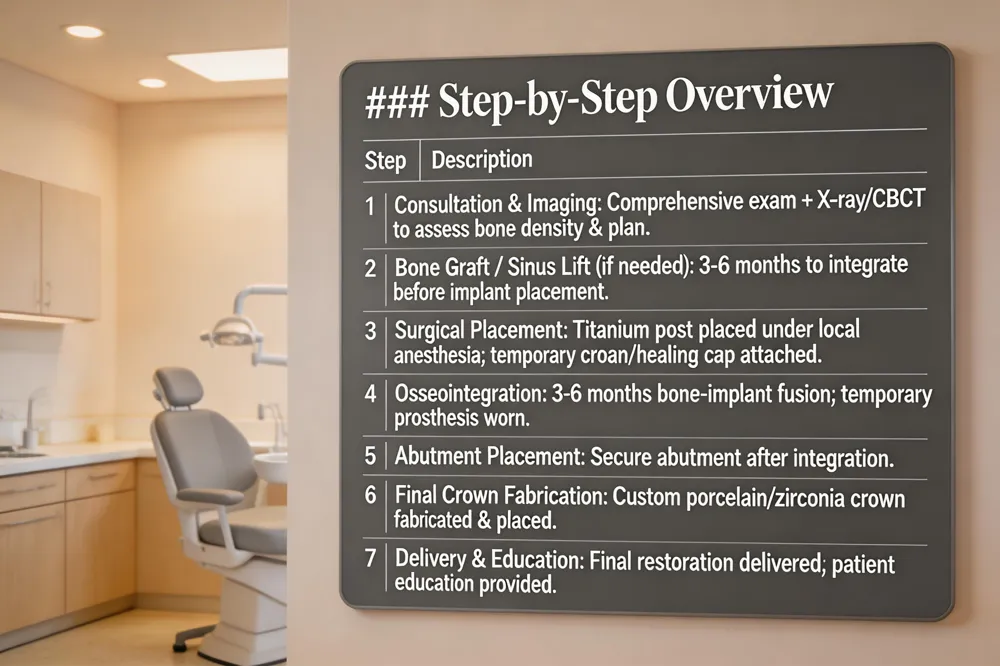 The implant journey begins with a comprehensive consultation and advanced imaging (X‑rays, CBCT) to evaluate oral health, bone density, and the need for bone grafting or a sinus lift. If the jaw lacks sufficient volume, a graft or lift is performed and allowed 3‑6 months to integrate. During the surgical phase, a titanium post is placed into a precisely drilled osteotomy under local anesthesia; a temporary crown or healing cap may be attached. Healing and osseointegration typically require 3‑6 months, during which the bone fuses to the implant, creating a stable foundation. Once integrated, an abutment is secured and a custom porcelain or zirconia crown is fabricated and placed, completing the restoration. For visual learners, our patient‑education portal offers high‑resolution, step‑by‑step photos of each stage—from imaging to final crown—available digitally or in printed form at your appointment.
Immediate Post‑Surgery Care
Immediate Care Timeline
| Time Frame | Actions |
|---|---|
| Day 0 (Surgery Day) | Apply gentle pressure with gauze or damp tea bag 30‑60 min; no brushing or rinsing. |
| Day 1‑2 | Begin soft‑food diet; ice packs for swelling; start warm salt‑water rinses 2‑3×/day; brush carefully on day 2. |
| Day 3‑7 | Continue soft foods; switch to moist heat after 48 h; maintain rinses; avoid smoking, straws, vigorous activity. |
| Day 8‑10 | Gradually re‑introduce normal foods; maintain oral hygiene; monitor for any signs of infection. |
| Beyond 10 days | Return to regular oral care routine; schedule follow‑up appointment. |
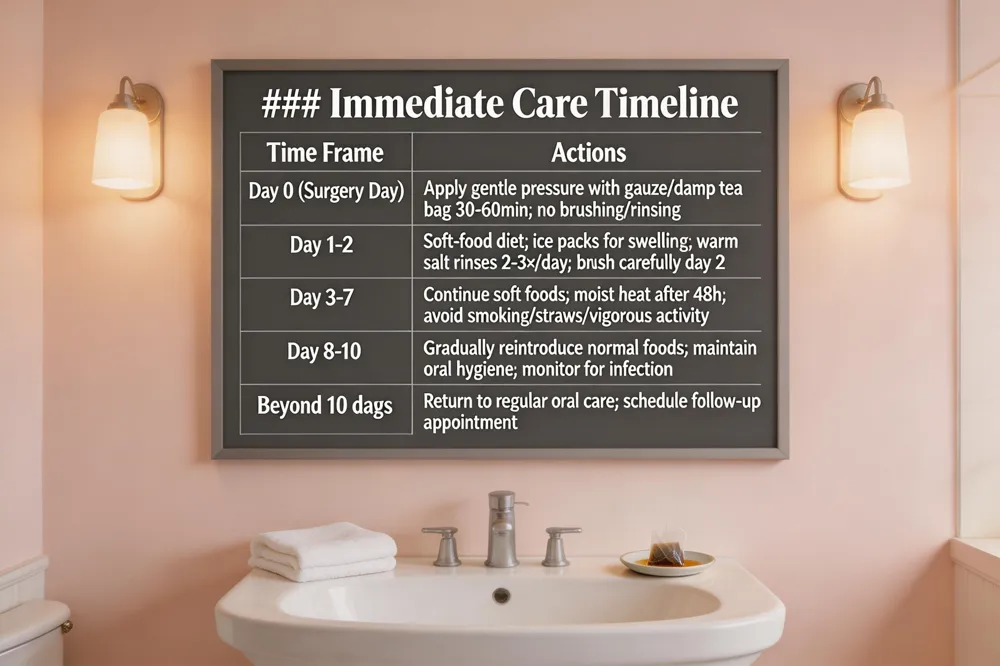 Home care after dental implant surgery: Apply gentle pressure with gauze or a damp tea bag for 30‑60 minutes, changing as needed until bleeding stops. Begin a soft‑food diet—smoothies, yogurt‑free pudding, mashed potatoes, and cool liquids—avoiding hot, spicy, crunchy foods and straws for the first 24‑48 hours. Do not brush or rinse on surgery day; on day 2, brush carefully around the incision with a soft‑bristled brush and rinse 2‑3 times daily with warm salt water (½ tsp salt per cup water). Control swelling with ice packs for 48 hours, then switch to moist heat if needed; take ibuprofen/acetaminophen and any prescribed antibiotics as directed. Refrain from smoking, straws, and vigorous activity for at least 10 days to protect the clot.
Why no dairy after dental implant: Dairy’s creamy texture can leave a sticky film on the surgical site, encouraging bacterial growth. It may also stimulate mucus production, increase inflammation, and interfere with antibiotics, potentially delaying clot formation and healing. Therefore, avoid dairy for 48‑72 hours and stick to non‑dairy soft foods until the area stabilizes.
Dental implant procedure step‑by‑step PDF: A clear, illustrated PDF outlining every stage—from consultation and imaging through bone grafting, implant placement, osseointegration, and final crown—can be requested at our Midland office or emailed electronically. Contact us for your personalized guide.
Long‑Term Maintenance and Hygiene
Maintenance Summary
| Aspect | Details |
|---|---|
| Home‑care tools | Soft‑bristle/ electric toothbrush, ultra‑soft interdental brushes, water flosser (e.g., Waterpik), antimicrobial mouthwash, implant‑specific scalers. |
| Professional cleaning cost | $100‑$300 per routine visit; $250‑$500 if prosthesis removed; $150‑$400 with exam & X‑rays. |
| Annual maintenance cost | $250‑$500 per year for a single implant (≈9 % of initial cost over 10 yr). |
| Frequency | Semi‑annual cleanings & exams; daily brushing & flossing. |
| Why needed? | Prevent peri‑implantitis, detect early bone loss, maintain prosthesis stability. |
 Dental implant cleaning tools
Keeping implants plaque‑free combines daily home‑care items with professional instruments. A soft‑bristle or gentle electric toothbrush and an interdental brush with ultra‑soft bristles gently remove debris around the crown and beneath the prosthesis. Water flossers (e.g., Waterpik) and a fluoride‑containing antimicrobial mouthwash disrupt biofilm in hard‑to‑reach areas. For deeper cleaning, implant‑specific scalers and curettes (Hu‑Friedy Implacare series, Nordent titanium scalters) safely polish the titanium surface without scratching it. Kits such as the TePe Implant Care Kit bundle these tools for convenient daily use.
Dental implant cleaning cost
Professional cleanings typically range from $100‑$300 per visit. When the prosthesis must be removed for a thorough cleaning, fees rise to $250‑$500, and a comprehensive exam with X‑rays can bring the total to $150‑$400. Insurance coverage is limited; many offices offer package discounts for routine maintenance.
Dental implant maintenance cost
Semi‑annual cleanings and exams usually cost $100‑$300 each, amounting to $250‑$500 per year for a single implant. Over ten years this represents roughly 9 % of the initial implant expense—about $1,200‑$1,500 in total upkeep. Occasional repairs (screw loosening, abutment fracture) add extra visits but are far less costly than untreated complications.
Do dental implants need maintenance?
Yes. Daily brushing with a soft brush, flossing (or floss threaders), and antimicrobial rinses keep gum tissue healthy and prevent peri‑implantitis. Regular professional check‑ups allow early detection of bone loss or component issues, ensuring the restoration remains secure.
How to clean dental implants at home
Brush twice daily with a low‑abrasive fluoride toothpaste, using small circular motions along the gumline. Clean between implants with an interdental brush, floss threader, or implant‑specific floss. Follow with a water flosser on a low setting and finish with an alcohol‑free antimicrobial mouthwash or warm salt water.
How to clean implants with Waterpik
Use the Plaque Seeker tip on the lowest pressure (level 2‑3), aiming at a 45‑90° angle toward the gumline. Sweep slowly around the implant for 30‑60 seconds per side, then rinse. Perform this routine twice daily alongside brushing.
Full‑Mouth and Specialized Cases
Full‑Mouth & Special Cases
| Topic | Highlights |
|---|---|
| Procedure steps | 3‑D imaging → extraction → graft if needed → place 4‑6 implants → provisional bridge → 3‑6 mo osseointegration → final custom bridge. |
| Care for full mouth | Brush twice daily with electric brush, water flosser under prosthesis, alcohol‑free antimicrobial rinse, avoid hard foods, regular dentist visits. |
| Autoimmune patients | Possible after thorough medical review, inflammation control, adequate bone, and more frequent follow‑ups. |
| Medicare coverage | Original Medicare (A/B) does NOT cover implants; only some Medicare Advantage (C) plans may offer limited dental benefits, but implants are usually excluded. |
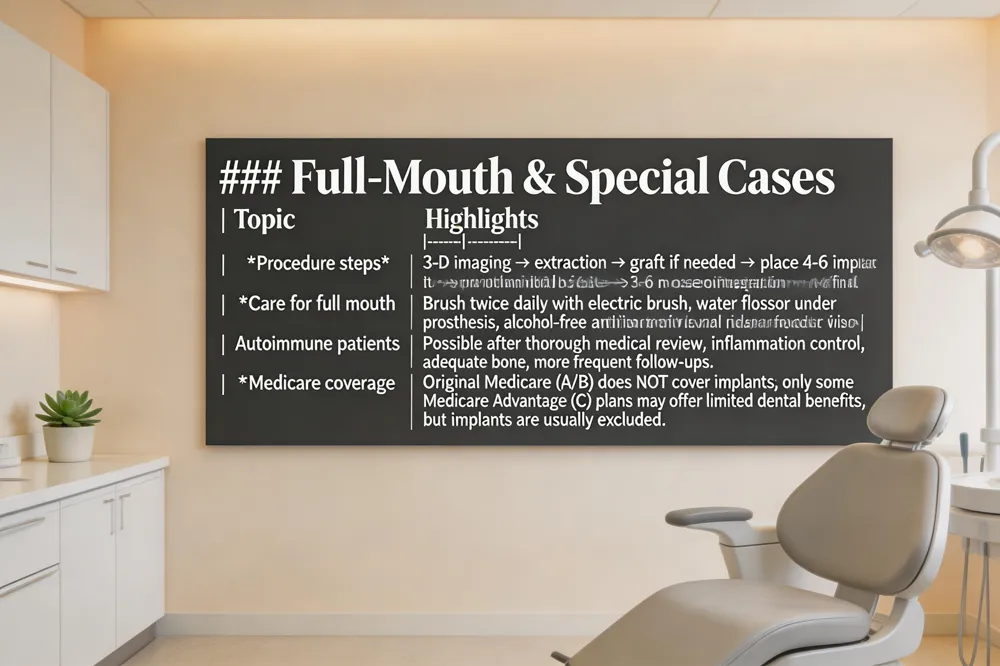
Full mouth dental implant procedure steps
Begin with 3‑D imaging and a digital plan, extract diseased teeth, bone graft if needed, place 4‑6 titanium implants, attach provisional bridge, wait 3‑6 months for osseointegration, then secure custom bridge.
How to care for full mouth dental implants
Brush twice daily with an electric brush and non‑abrasive toothpaste, clean under the prosthesis with a water flosser, rinse with alcohol‑free antimicrobial mouthwash, avoid foods, and see the dentist months.
Can people with autoimmune disease get dental implants?
Yes, after a thorough medical review and coordination with your physician to control inflammation, ensure adequate bone, and schedule more frequent check‑ups for early detection of complications.
Is it true that Medicare now pays for dental implants?
No. Original Medicare (Parts A/B) does not cover implants; only some Medicare Advantage plans may offer limited dental benefits, but implants are usually excluded. Use private insurance or savings options.
Implant Longevity and Future Outlook
Longevity & Outlook
| Metric | Figure |
|---|---|
| 10‑year success | 90‑95 % |
| 20‑year success | >95 % (implant stable, crown may need replacement) |
| 25‑year outlook | Implant still functional; prosthetic restoration often renewed after 10‑20 yr. |
| Implant types | Endosteal, Subperiosteal, Zygomatic |
| Hygienist role | Implant‑safe cleanings, peri‑implant tissue assessment, patient education, coordination with dentist for risk‑factor management. |
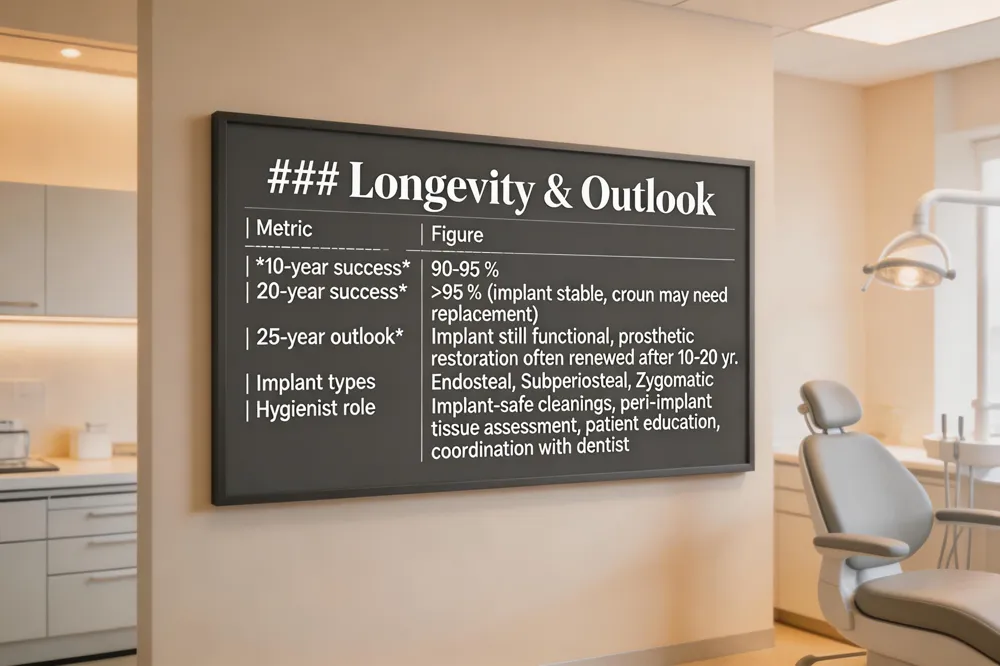 Dental implants boast long‑term success rates of 90‑95 % after ten years and often exceed 95 % over two decades when patients practice diligent oral hygiene and attend regular check‑ups. After 20 years the titanium post typically remains fused to bone, while the crown may need replacement due to wear. By 25 years the implant can still function a lifelike, but the prosthetic restoration often requires renewal after 10‑20 years. The three main implant types are endosteal (screw‑like posts in bone), subperiosteal (frameworks atop bone), and zygomatic (anchored in the cheekbone for severe bone loss). Hygienists play a vital role: they perform thorough cleanings with implant‑safe instruments, assess peri‑implant tissue health, educate patients on brushing, flossing and antimicrobial rinses, and coordinate with the dentist to monitor risk factors such as smoking or uncontrolled diabetes, ensuring implants remain stable for decades.
Your Smile, Our Commitment
From the first consultation and imaging to the surgical placement of a titanium post, the healing phase of osseointegration, and the final attachment of an abutment and custom crown, the dental‑implant journey restores function and confidence. Yet long‑term success hinges on diligent maintenance: brushing twice daily with a soft‑bristled brush, daily flossing or water‑flossing, antimicrobial mouthwash, and regular professional cleanings at least twice a year to detect peri‑implantitis early. In Midland, Texas, Dr. Ashley E. Burns, DDS, offers comprehensive planning, precise surgery, and personalized after‑care programs that keep your implants healthy for decades.