Embracing the Digital Revolution in Dental Care
Intraoral scanners have transformed dental practice by replacing traditional impression trays and alginate or silicone materials with instant, high‑resolution 3‑D digital models. This shift from analog to digital workflows streamlines every step: clinicians capture a scan in seconds, software stitches the images into a seamless model, and the data is sent instantly to CAD/CAM or lab systems. The result is faster case completion, fewer appointments, and a dramatic reduction in material waste.
Patients experience markedly greater comfort—no gag‑inducing trays, no unpleasant taste, and a brief, painless scan that can be viewed on‑screen in real time. Clinicians receive immediate visual feedback, allowing on‑the‑spot correction and eliminating repeat impressions.
For practices, the digital transition drives growth. Faster turnaround shortens treatment cycles, increasing case acceptance and patient volume. Eliminating disposable supplies cuts costs and supports sustainability, while cloud‑based data storage reduces physical space and enhances security. Overall, intraoral scanners deliver a win‑win for patients, clinicians, and the planet.
Top 10 Intraor Scanners Dominating the 2026 Market
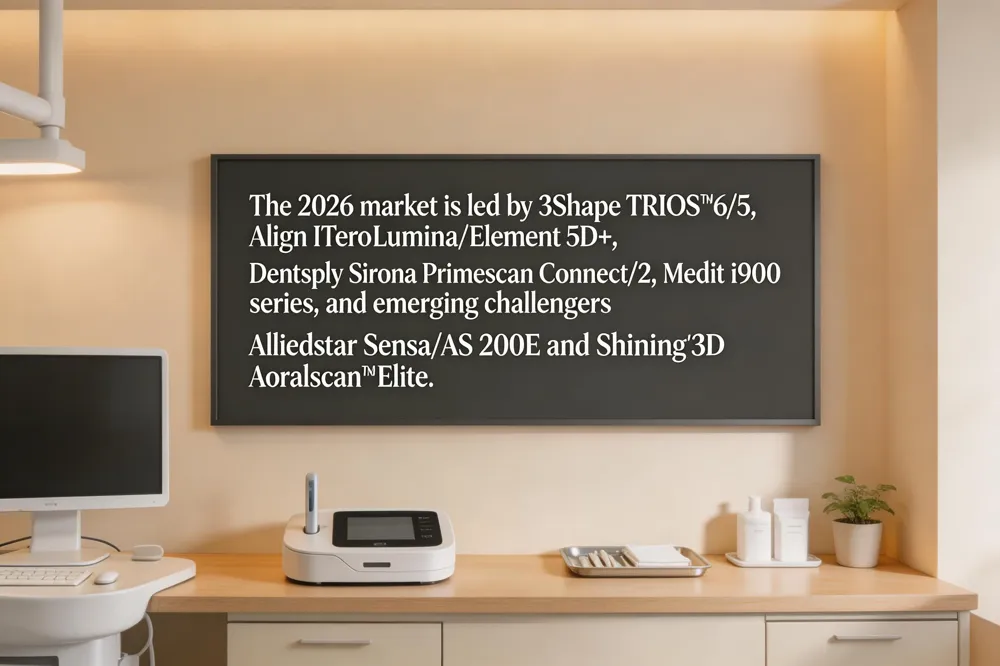 Top 10 intraoral scanners (2026 market)
The 2026 market is led by 3Shape TRIOS 6 and TRIOS 5, prized for ultra‑fast image capture and seamless CAD/CAM integration. Align Technology’s iTero Lumina and iTero Element 5D+ dominate orthodontic and Invisalign workflows with cloud‑based data sharing. Dentsply Sirona’s Primescan Connect and Primescan 2 set the benchmark for full‑arch and implant accuracy, delivering sub‑10 µm precision. Medit’s i900 series (including the wireless i900 Mobility) and i500 provide high‑resolution scans and an open‑architecture software ecosystem. Emerging challengers round out the top ten: Alliedstar Sensa, Alliedstar AS 200E, and Shining 3D Aoralscan Elite, each offering wireless flexibility, AI‑guided scanning, and photogrammetry for complex prosthetic cases.
Leading dental scanner brands
The most respected brands are 3Shape (TRIOS series), Align Technology (iTero Lumina, Element), Medit (i900, i700), Carestream (CS 360, CS 130), Planmeca (Emerald, ProScan), Dentsply Sirona (Primescan, CEREC‑Omnicam), Straumann and Nobel Biocare (implant‑focused scanners), Vatech and DEXIS (cost‑effective options). Their dominance stems from proven accuracy, robust software ecosystems, extensive support networks, and continuous innovation in speed, ergonomics, and cloud integration.
How Intraoral Scanners Work – The Science Behind the Scan
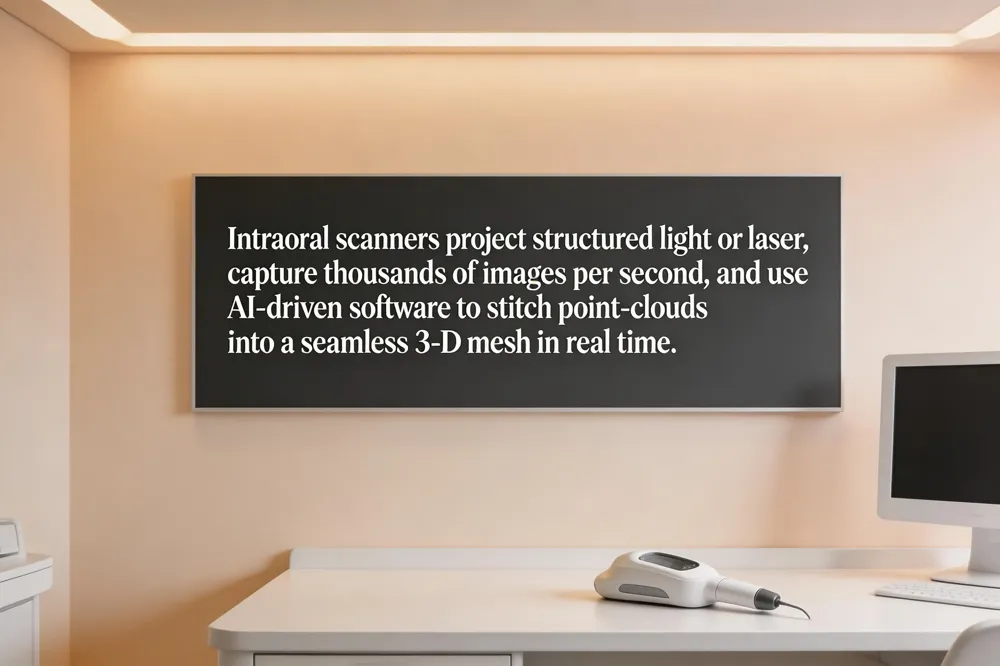 Intraoral scanners are handheld optical devices that project patterned light—typically structured light or a low‑power laser—onto the teeth and surrounding soft tissues. High‑resolution cameras capture the reflected light, acquiring thousands of images per second that form tiny 3‑D sub‑scans or point‑clouds. Embedded software processes these data in real time, stitching the point‑clouds together with advanced algorithms that filter out saliva, tongue and other artifacts. The result is a seamless, color‑rendered 3‑D mesh of the patient’s dentition that can be examined instantly on a monitor.
How does an intraoral scanner work?
An intraoral scanner projects a patterned light onto the oral cavity; the reflected light is captured by high‑resolution sensors, creating thousands of images per minute. AI‑driven software instantly stitches these images into a continuous 3‑D model, correcting motion artifacts and reflections. The final digital impression is displayed in real time and can be exported in standard formats (STL, OBJ, PLY) for diagnosis, treatment planning, or direct CAD/CAM design.
Adoption Rates: How Many Dentists Are Using Intraoral Scanners?
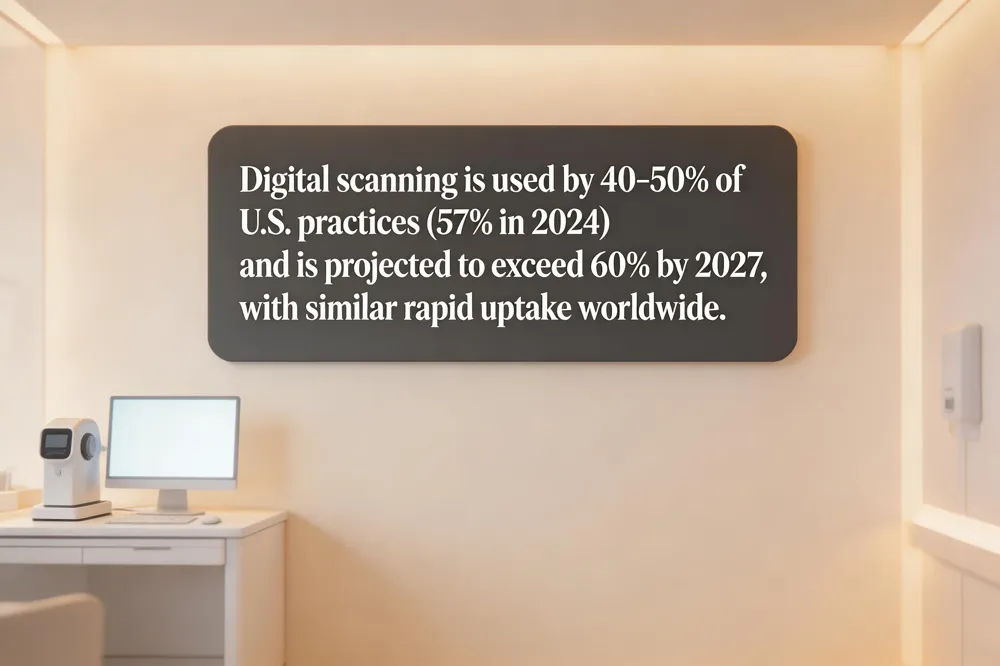 Intraoral scanners have become mainstream in U.S. dentistry. Recent reports indicate that about 40 %–50 % of American dental offices already employ digital scanning, with a 2024 year‑end review citing a 57 % penetration rate. The trend is upward: industry forecasts predict adoption will surpass 60 % by 2027 as costs fall and cloud‑based workflows mature. International data echo this rapid uptake, showing over three‑quarters of clinicians using scanners daily. The growing prevalence reflects both clinician demand for accuracy, efficiency, and patient preference for a more comfortable, gag‑free impression experience.
Step‑by‑Step Intraoral Scanning Technique for Clinicians
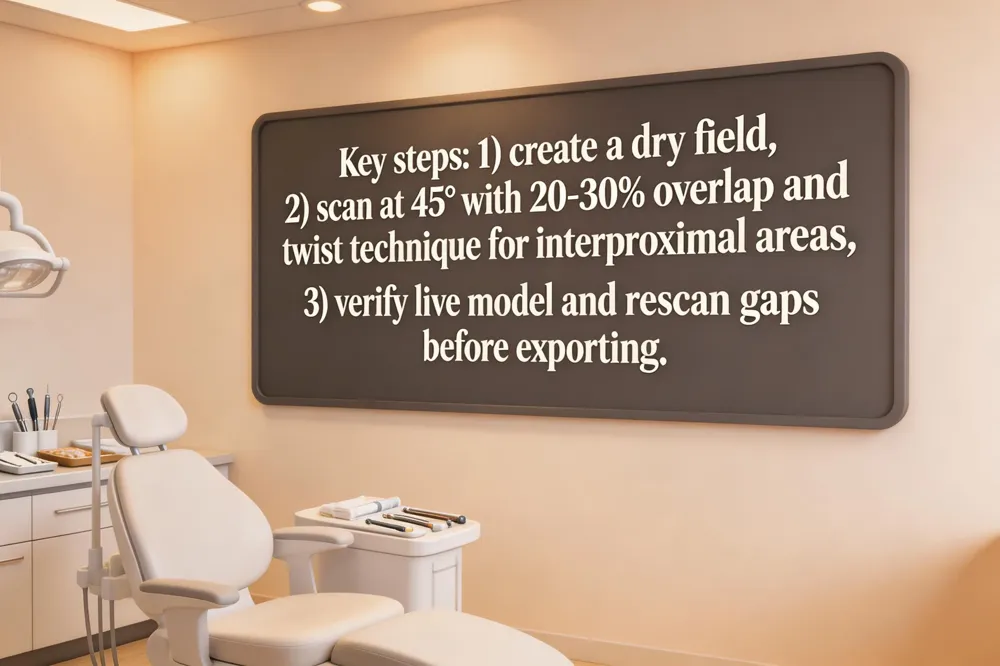 Intraoral scanning technique – step‑by‑step
1️⃣ Preparation of a dry field – Dim ambient lights, use the air‑water syringe and high‑volume suction to dry teeth and soft tissue, and place cheek retractors to create a clear, moisture‑free workspace. A dry field prevents light scattering and ensures accurate image capture.
2️⃣ Scanning angles and overlap – Hold the scanner with a steady grip and position the tip at a 45° angle to the tooth surface. Begin with the occlusal view of the posterior quadrant, then sweep smoothly across buccal and lingual/palatal surfaces. Overlap each pass by 20‑30 % and use the “twist technique” in interproximal areas—slightly rotating the wand while moving—to capture hidden margins without data loss.
3️⃣ Live verification and repeat scans – After completing each quadrant, review the live 3‑D model for gaps or artifacts. If any area appears incomplete, rescan that segment immediately. Once the full arch is captured, the software stitches the images into a seamless model, which can be exported (STL/OBJ) for CAD/CAM design or laboratory transmission.
Digital vs. Conventional Impressions – Clinical Impact
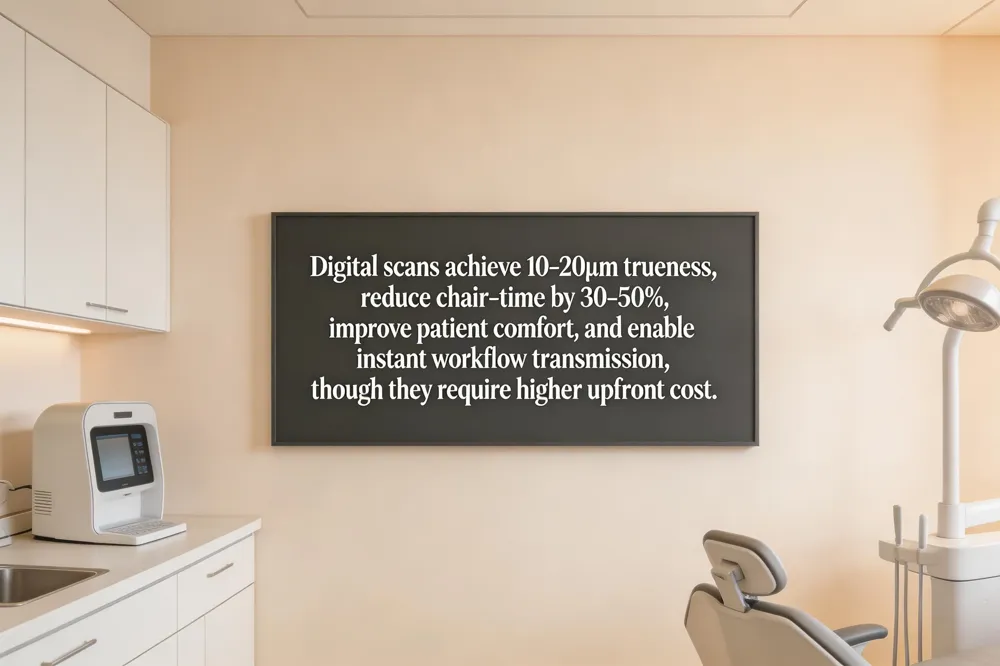 Intraoral scanners transform the impression workflow by creating an instant, high‑resolution 3‑D model of the dentition, eliminating the need for messy trays and impression material. This digital capture removes the distortion, shrinkage, and voids that can occur with polyvinyl‑siloxane or alginate, delivering accuracy that meets or exceeds conventional methods for single‑tooth and short‑span restorations. Studies show trueness within 10‑20 µm, comparable to the 40 µm achievable with high‑quality analog impressions, and a 2024 systematic review reported statistically superior precision for digital scans in most clinical scenarios.
Patient experience is markedly improved. The small handheld wand glides over teeth without the unpleasant taste, cold sensation, or gag‑inducing bulk of traditional trays. Chair‑time for a complete arch scan is typically 30‑90 seconds, a 30‑50 % reduction compared with the 5‑10 minutes needed for material setting and removal of conventional impressions. Surveys consistently show higher comfort scores and a preference for digital scanning.
Workflow efficiency rises because the scan is processed in real‑time, allowing clinicians to verify coverage instantly and correct gaps on the spot. The digital file is transmitted instantly to the laboratory or to an in‑office CAD/CAM system, shortening turnaround time and enabling same‑day milling or 3‑D printing of crowns, bridges, and aligners. Digital records also simplify storage, retrieval, and patient communication while reducing material waste and infection‑control concerns.
Advantages of intraoral scanners include high accuracy, rapid acquisition, ergonomic design, and seamless integration with CAD/CAM and cloud platforms. Disadvantages involve a significant upfront cost (often $15,000‑$80,000), a learning curve for optimal scanning technique, and sensitivity to moisture or reflective surfaces, which can necessitate strict isolation and retraction. Reliable internet connectivity and regular software updates are also required.
Overall, multiple recent studies confirm that intraoral scanners provide accuracy comparable to—or better than—traditional impressions, while delivering superior patient comfort and markedly improved practice efficiency. For most restorative and orthodontic cases, digital scanning is now the preferred, patient‑friendly alternative, though analog impressions may still be advantageous for extensive edentulous arches or soft‑tissue‑intensive procedures.
Practical Considerations: Costs, Options, and Local Access
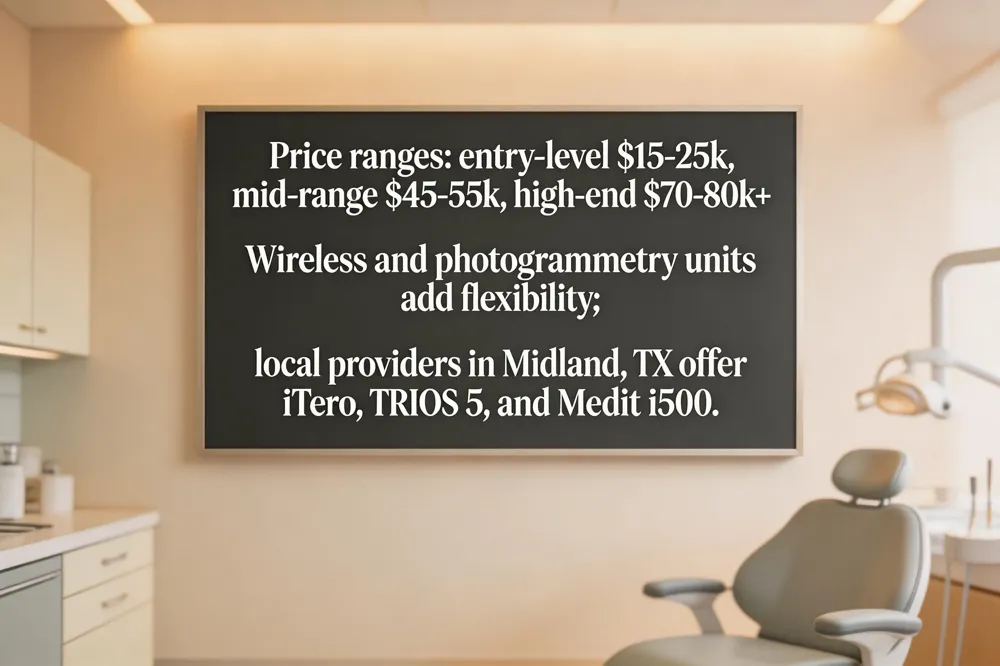 Intraoral scanner price ranges vary widely. Basic entry‑level units such as the Medit i500 or Identica T300 start around $15,000‑$25,000. Mid‑range models like 3Shape Trios 4, Sirona Cerec Omnicam, or Medit i700 fall in the $45,000‑$55,000 range. High‑end systems—including Align iTero Element 5D, 3Shape TRIOS 5, and Dentsply Sirona Primescan—often cost $70,000‑$80,000 or more, with additional annual service fees. Wireless scanners (Alliedstar AS 200E) are found around $20,000‑$30,000, while premium photogrammetry‑ready units like Shining 3D Aoralscan Elite may exceed $100,000.
Patients typically pay $100‑$300 extra for a digital dental impression, though many practices bundle this fee into the overall treatment cost. Insurance may cover part of the impression cost when it is integral to crowns, bridges, or orthodontic appliances, but most plans treat it as a component of the restorative service rather than a stand‑alone procedure.
For denture workflows, the 3Shape TRIOS 5 is widely regarded as the best scanner because of its high‑resolution cameras and AI‑driven algorithms that capture full‑arch, edentulous anatomy with precision. A more budget‑friendly option is the Medit i500, which delivers comparable accuracy and integrates smoothly with denture‑design software. Clinicians preferring a cloud‑based platform may consider the iTero Lumina, while the Shining 3D Aoralscan Elite provides reliable full‑arch capture at a modest price.
In Midland, Texas, digital impressions are offered at several practices: Dr. Ashley E. Burns, DDS (iTero scanner), the Smile Suite led by Dr. Mallory Gonzales, Michael S. Connally, DDS, and Smile Straight Orthodontics. Each utilizes state‑of‑the‑art intraoral scanners for restorative, orthodontic, and implant cases.
Educational videos can be found on the official 3Shape YouTube channel ("Trios 5 – How It Works", 4 min) and on Dr. Ashley E. Burns’s website, which demonstrate the scanning process and patient benefits.
Future Outlook: New Dental Technologies Shaping 2026
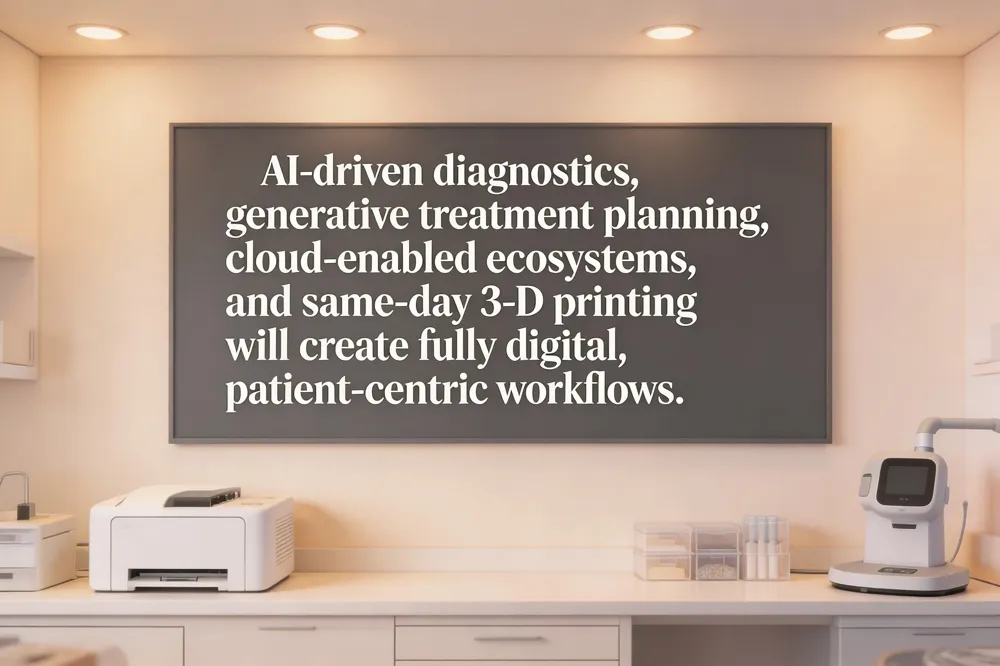 In 2026, the dental landscape is being transformed by three converging innovations. AI‑driven diagnostics and workflow automation now act as virtual coworkers, handling patient intake, speech‑to‑text charting, and multi‑step treatment planning. Advanced deep‑learning algorithms instantly analyze intra‑oral scans, CBCT data, and radiographs, flagging caries, margin lines, and soft‑tissue anomalies with accuracy that rivals specialist review. Generative AI for treatment planning takes those diagnostics a step further, automatically producing 3‑D treatment simulations, smile‑design mock‑ups, and even AI‑generated design files for crowns, bridges, and clear aligners. Clinicians can show patients a realistic, real‑time visualization of the final result, boosting case acceptance and shared decision‑making. Cloud‑enabled ecosystems and same‑day 3‑D printing complete the digital loop. High‑resolution intra‑oral scanners capture a full‑arch impression in seconds, stitch the data in real time, and upload the STL file to a secure, HIPAA‑compliant cloud platform. From there, AI‑assisted CAD software prepares the restoration design, which is sent instantly to an in‑office 3‑D printer or milling unit. The result is a same‑day, fully customized prosthesis—crown, bridge, or implant abutment—fabricated with micron‑level accuracy. Together, these technologies create a seamless, patient‑centric workflow that reduces chair time, eliminates material waste, and elevates the standard of care across restorative, orthodontic, and implant dentistry.
The Digital Standard Is Here to Stay
Digital intraoral scanning has become the new norm in modern dentistry, with over half of U.S. practices already using it and adoption rates climbing past 57% in 2024. The technology delivers precise 3‑D impressions in seconds, eliminating mess‑creating trays, unpleasant tastes, and gag‑inducing materials. Patients enjoy a more comfortable, faster experience, while clinicians benefit from real‑time visual feedback, reduced chair‑time, and higher‑accuracy restorations that require fewer adjustments. Immediate digital communication with laboratories shortens turnaround, allowing same‑day crowns, bridges, and aligners. Our practice has fully integrated this cutting‑edge workflow, combining wireless scanners, cloud‑based storage, and AI‑assisted design to ensure every case is planned and fabricated with the highest precision. We invite you to experience the benefits of digital care—more comfort, clearer communication, and faster results—because staying at the forefront of technology is our promise to you. Schedule a consultation today and see how our digital workflow transforms your treatment journey.