Introducing Robotic Precision in Implant Dentistry
Precision is the cornerstone of successful dental implant therapy. Sub‑millimeter placement accuracy minimizes the risk of nerve injury, sinus perforation and excessive bone trauma, which are the primary causes of postoperative pain and implant failure. Modern robotic systems such as Yomi™ achieve this accuracy by integrating cone‑beam CT (CBCT) data with intra‑oral scans to create a virtual 3‑D model of the patient’s jaw. The digital workflow begins with this imaging, proceeds through computer‑aided design (CAD) of the optimal implant size, angle and depth, and culminates in real‑time robotic guidance that delivers haptic and visual feedback to the clinician. During surgery the robot tracks patient motion, enforces the pre‑planned trajectory, and provides a “hard stop” at the target depth, allowing minimally invasive flap‑less approaches. Patients benefit from shorter operative times (up to 30 % reduction), less intra‑operative bleeding, reduced postoperative swelling, and faster healing. The predictability of robotic placement also improves long‑term prosthetic stability and patient confidence, making implant therapy safer and more comfortable for the modern dental patient.
How Robotic Guidance Improves Implant Placement
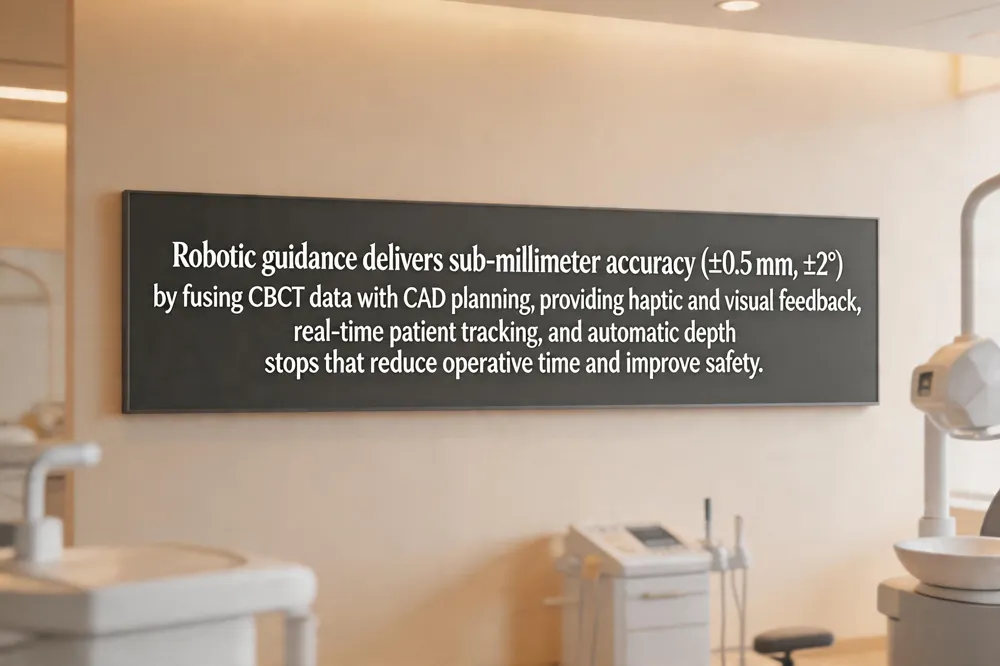 Robotic guidance brings sub‑millimeter accuracy to dental implant surgery. By fusing cone‑beam CT scans with CAD planning, the robot translates a virtual 3‑D model into a physical drill trajectory that stays within ±0.5 mm and ±2° of the planned position, far tighter than the 1–2 mm deviation typical of free‑hand placement.
Haptic and visual feedback – The robotic arm provides real‑time tactile resistance when the drill veers off the pre‑planned path and overlays the planned trajectory on a screen, allowing the clinician to feel and see any deviation instantly. This haptic "hard stop" prevents over‑drilling and protects vital structures such as the inferior alveolar nerve or maxillary sinus.
Real‑time patient tracking – Real‑time patient tracking monitors head motion; if the patient shifts, the system automatically recalibrates the guidance, maintaining alignment throughout the osteotomy.
Is robotic surgery more precise? Yes. Multiple clinical studies report placement accuracy within 0.5 mm and angular deviation under 2°, a significant improvement over conventional techniques.
Robotic dental implant surgery – FDA‑cleared platforms like Yomi S guide the drill with haptic, visual, and voice‑controlled feedback, enabling minimally invasive, flapless procedures and same‑day restoration.
Robot‑assisted implant placement – The workflow starts with a CBCT‑based 3‑D plan; the robot steers the drill to the exact depth and angulation, stabilizing the surgeon’s hand and stopping at the preset depth, which reduces operative time by up to 30 % and postoperative discomfort.
What is robotic‑assisted implant placement? It is a computer‑guided, surgeon‑controlled system that combines optical tracking and haptic feedback to execute the virtual surgical plan with high precision, enhancing safety and predictability for patients.
The Yomi System: Features, Costs, and Patient Access
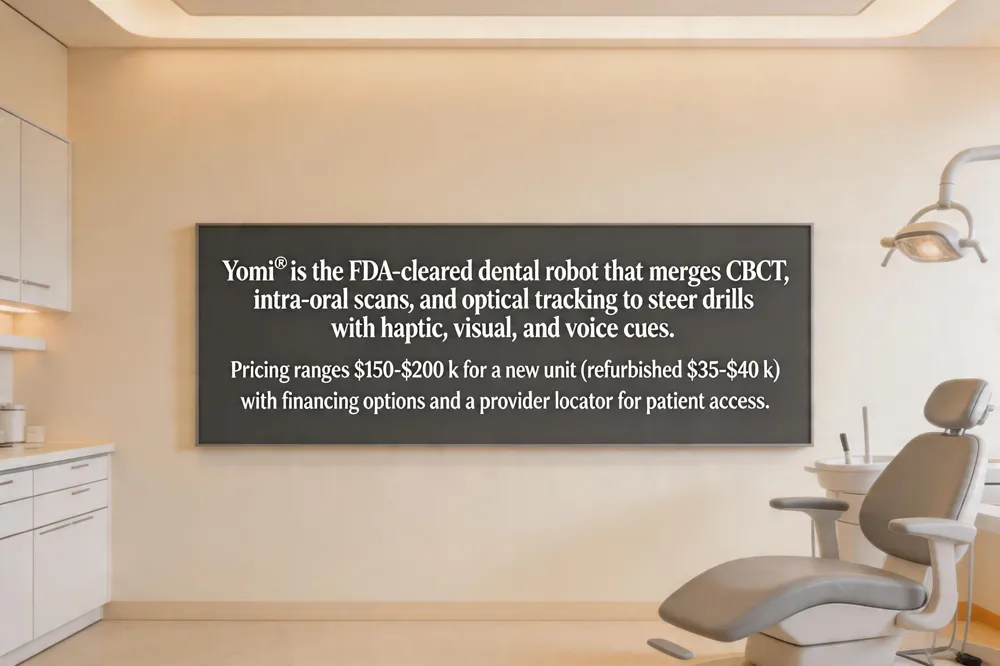 The Yomi® dental robot is the first and only FDA‑cleared robotic platform for implant surgery in the United States, having received clearance in 2017 and subsequent updates for full‑arch and bone‑reduction procedures. Its workflow begins with a cone‑beam CT (CBCT) scan and intra‑oral digital impression, which are merged into a virtual surgical plan. During the operation the robot arm provides real‑time visual, auditory, and haptic feedback, physically steering the drill and applying a hard stop when the planned depth is reached, thus keeping the drill within the pre‑planned trajectory and protecting vital structures.
Pricing for a Yomi system ranges from $150,000‑$200,000 USD for a new unit, with additional costs for training, maintenance contracts, and consumables. Financing options commonly include monthly payments of $600‑$800 USD, and refurbished units may be found for $35,000‑$40,000 USD, albeit with older software.
To locate a provider, visit the Neocis website and use the “Yomi Provider Locator,” which lists practices by state, distance, and specialty. For example, patients in Midland, Texas can contact Dr. Ashley E. Burns, DDS, to confirm Yomi availability or be referred to a nearby Yomi Center of Excellence.
Yomi dental robot near me: Use the Neocis Provider Locator tool on their website to find qualified offices near you, filtering by location, language, and specialty.
Yomi dental robot price: Base system cost $150‑$200 k, with financing options and refurbished units around $35‑$40 k; expect additional training and maintenance expenses.
Yomi dental robot reviews: Clinicians cite sub‑millimeter accuracy, reduced chair time, and minimally invasive flap‑less surgery as major benefits; challenges include a steep learning curve and high upfront cost.
Neocis Yomi: An FDA‑cleared robotic platform that integrates CBCT imaging, optical tracking, and haptic guidance to deliver precise, same‑day, minimally invasive implant placement while keeping the dentist in full control.
Key Players Shaping the Dental Robotics Landscape
 Dental robotics companies – Key U.S. players are Neocis (Yomi), Dentsply Sirona, Align Technology, Straumann, Zimmer Biomet, Navigate Surgical Technologies, and X‑Nav. Emerging firms include 3Shape, Osstem, Brain Navi, and Dental Monitoring.
Neocis Stock – Neocis is privately held; no public ticker exists. Shares trade on secondary private‑market platforms (e.g., Forge, EquityZen) for accredited investors, with a recent valuation of roughly $281.6 million (Series 1‑D, Jan 2024).
Dental assistant robot – Systems such as iQube, Zeeno, and the Yomi drill‑guidance robot streamline instrument delivery, surface disinfection, and patient interaction, reducing chair time and improving the patient experience.
How close are we to robotic implants? – Robotic implant placement is already a clinical reality (Yomi, Yakebot). Accuracy exceeds free‑hand techniques, but broader adoption is limited by cost, training, and workflow integration. Continued AI‑driven planning and compact hardware are rapidly closing the gap, making routine robotic assistance imminent, while fully autonomous surgery remains a few years away.
Patient‑Centric Benefits, Risks, and Special Considerations
 Robotic‑assisted implant surgery offers several patient‑centric advantages. The haptic guidance and sub‑millimeter accuracy of systems such as Yomi™ minimize bone trauma, which translates into less intra‑operative bleeding, reduced postoperative swelling, and a faster healing trajectory. Because the drill is steered along a pre‑planned trajectory, the procedure can often be performed flaplessly, further decreasing tissue disruption and post‑operative discomfort.
What’s the most painful part of a dental implant? The greatest discomfort typically occurs during the postoperative healing phase, especially the first 48‑72 hours. Patients report soreness, swelling, and tenderness comparable to a tooth extraction, which can be managed with OTC analgesics. The actual drilling is performed under local anesthesia and is usually only a brief, mild pressure.
What is the biggest problem with dental implants? Infection, particularly peri‑implantitis, remains the most significant complication. Bacterial colonisation can lead to bone loss and implant failure, requiring antibiotics, grafts, or removal. Nerve or tissue injury is less common but also a concern.
Can a person with lupus get dental implants? Autoimmune conditions like lupus can impair gum healing and osseointegration, but they do not automatically disqualify a patient. A thorough medical evaluation and close coordination with the oral surgeon are essential to assess risk and plan appropriate peri‑operative management.
Dental robot price A new Neocis Yomi system typically costs $150,000‑$200,000 USD, with refurbished units ranging $19,000‑$40,000. Ongoing expenses include annual software licensing, consumables, and possible financing plans.
Education, Training, and Practice Integration
 Robotic dentistry courses
Dental professionals can access a growing array of continuing‑education (CE) programs focused on robotic implantology. The University of Texas School of Dentistry offers an ADA‑accredited curriculum, while Neocis’s Yomi U platform provides online modules, hands‑on workshops, and a mastery program that walks clinicians through the full Yomi workflow. The American Academy of Robotic and Digital Dentistry (AARDD) and the University of Washington also host live webinars and CE‑credit courses that blend theory with practical simulation.
Robotic dentistry courses
Dental professionals can access a growing array of continuing‑education (CE) programs focused on robotic implantology. The University of Texas School of Dentistry offers an ADA‑accredited curriculum, while Neocis’s Yomi U platform provides online modules, hands‑on workshops, and a mastery program that walks clinicians through the full Yomi workflow. The American Academy of Robotic and Digital Dentistry (AARDD) and the University of Washington also host live webinars and CE‑credit courses that blend theory with practical simulation.
Learning curve and ROI Initial adoption requires a learning curve—typically 20‑30 supervised cases before a clinician feels fluent. However, clinical studies show that robotic guidance reduces operative time by 15‑30 % and improves placement accuracy, translating into higher implant survival rates and fewer revisions. Practices that integrate robotics often see a 60 % increase in implant volume within six months, offsetting the upfront investment and delivering a favorable return on investment.
Future workflow enhancements The next generation of robotic platforms will merge AI‑driven predictive analytics with real‑time navigation, allowing automatic adjustment of drill speed and torque based on bone density. Seamless integration with intra‑oral scanners, CAD/CAM design, and cloud‑based treatment planning will further streamline same‑day implant placement, enhancing efficiency and patient satisfaction.
Dental robotics companies Key U.S. innovators include Neocis (Yomi), Dentsply Sirona, Align Technology, Straumann, Zimmer Biomet, Navigate Surgical Technologies, and X‑Nav Technologies. Emerging firms such as 3Shape, Osstem Implant, Brain Navi Biotechnology, and Dental Monitoring are expanding the market with AI‑enhanced solutions.
Dental robot price A new Yomi system typically costs $150,000‑$200,000 USD, with refurbished units ranging $19,000‑$40,000. Ongoing expenses include annual software licensing, consumables, and optional financing plans.
Robotics Are Changing the Implant Experience at Ashley E. Burns, DDS
Robotic assistance has become a cornerstone of implant therapy at Ashley E. Burns, DDS, delivering unprecedented precision and safety. Using FDA‑cleared systems such as the Yomi™ robot, the practice integrates cone‑beam CT scans and intra‑oral digital impressions to generate a 3‑D virtual plan. The robotic arm provides real‑time haptic feedback and a hard‑stop at the planned depth, keeping the drill within a sub‑millimeter trajectory and protecting vital structures such as the inferior alveolar nerve and maxillary sinus. This accuracy translates into consistent angulation, primary stability and higher long‑term survival rates.
Patients experience markedly less postoperative discomfort because the robot enables flapless, minimally invasive drilling, reducing tissue trauma, bleeding and swelling. Average chair time per implant drops to about six minutes, allowing same‑day placement and provisional restoration, which shortens overall treatment time and improves satisfaction.
Adopting robotic technology positions the practice as future‑ready. Ongoing AI‑driven planning modules and dynamic navigation will further personalize implant design based on bone quality, ensuring that Ashley E. Burns, DDS remains at the forefront of digital, patient‑centered implant dentistry. It underscores the practice’s dedication to cutting‑edge, patient‑focused care.