Welcome to a New Smile Journey
Full‑mouth rehabilitation is a comprehensive, multidisciplinary process that restores the health, function, and aesthetics of every tooth, gum, and jaw. By addressing severe decay, worn dentition, gum disease, and bite discrepancies in a single, coordinated plan, the treatment delivers durable results that a isolated procedures cannot achieve. Dr. Ashley E. Burns, DDS, combines state‑of‑the‑art imaging (3‑D CBCT, intra‑oral scanners), digital design, and a team‑based approach that includes periodontists, oral surgeons, and prosthodontists. Patients can expect a clear roadmap: an initial diagnostic phase, preparatory surgery or extractions, implant placement with osseointegration, provisional restorations for functional testing, and final custom crowns or bridges refined with computerized occlusal analysis. Throughout, Dr. Burns emphasizes patient education, comfort, and personalized aesthetic goals, ensuring each step aligns with the ultimate vision of a healthy, natural‑looking smile.
What Is Full‑Mouth Rehabilitation and the Role of Prosthodontics
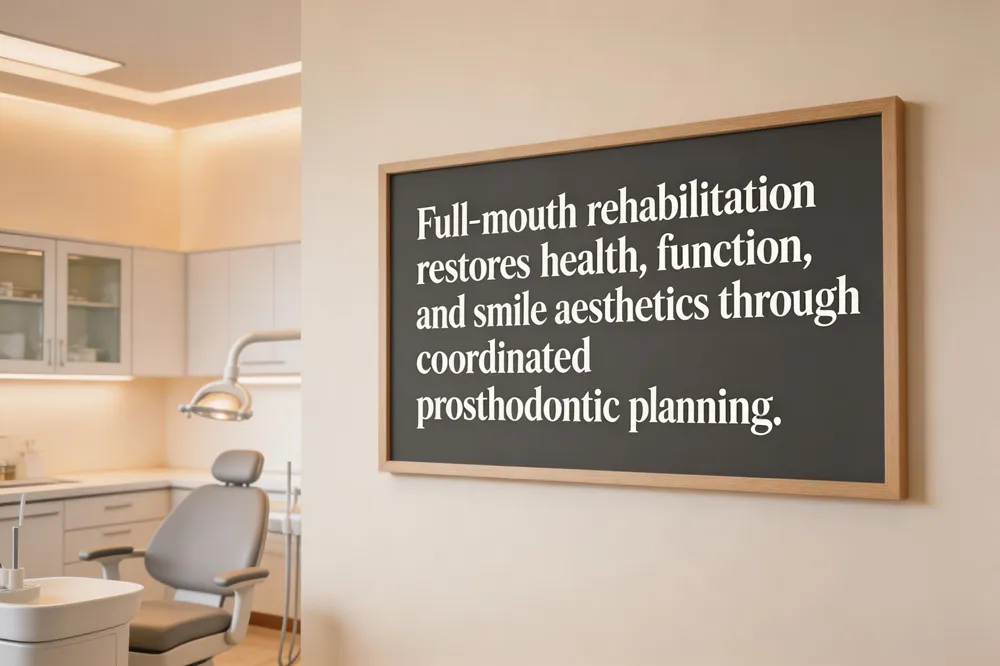 Full‑mouth rehabilitation, also called full‑mouth reconstruction, is a coordinated, interdisciplinary treatment plan that restores the health, function, and appearance of every tooth, gum, and bite in a patient’s mouth. It typically combines crowns, bridges, veneers, implants, dentures, and sometimes orthodontic or periodontal therapy to address extensive decay, missing or damaged teeth, severe wear, and TMJ issues. The process begins with a comprehensive evaluation—including digital scans, X‑rays, and bite analysis—to create a customized plan that meets both functional and aesthetic goals.
Prosthodontics, the specialty devoted to the replacement of missing teeth and the restoration of damaged dentition, drives the planning, design, and placement of the prosthetic restorations. In full‑mouth rehabilitation prosthodontists coordinate the rebuilding of the dentition, re‑establish the vertical dimension of occlusion, and achieve a stable, functional bite. They collaborate with periodontists, orthodontists, and oral surgeons for bone grafting, gum contouring, or orthognathic procedures, ensuring that esthetics, periodontal health, and TMJ function are all addressed. This interdisciplinary approach, guided by prosthodontic expertise, delivers a natural‑looking, durable smile that improves chewing efficiency, speech, and overall confidence.
Timeline, Costs, and Insurance Realities
 A full‑mouth rehabilitation is a multi‑phase journey that can span anywhere from a few weeks to a year, depending on case complexity. The process typically starts with a 1–2 week consultation and diagnostic phase, followed by preparatory work (extractions, periodontal therapy, bone grafts) that may require 2–6 weeks of healing. If implants are part of the plan, a surgical placement and a 3–6‑month osseointegration period are added before definitive crowns or bridges are fabricated. Final adjustments, polishing, and cosmetic refinements usually take an additional 2–4 weeks. In total, a straightforward, non‑implant case may be completed in 2–4 months, while a comprehensive implant‑supported reconstruction often extends to 6–12 months. Key factors that influence the schedule include the number of teeth involved, the need for bone augmentation, the patient’s healing response, and whether orthodontic or aesthetic procedures are incorporated.
Cost varies widely. A modest makeover with basic crowns can start around $15,000, whereas a full‑arch implant‑supported restoration can exceed $80,000. The average U.S. patient spends $30,000–$40,000 for a comprehensive rebuild. Prices are driven by the type of restoration (implants ≈ $5,000 per unit, crowns $500–$2,000 each), material selection, provider expertise, and geographic location.
Insurance coverage is nuanced. Medically necessary components—such as extractions, periodontal treatment, implant placement, and prosthetic crowns—may be partially reimbursed by dental PPO or HMO plans, typically covering 50‑80 % up to the annual maximum ($1,000–$2,000). Purely cosmetic procedures (veneer whitening, aesthetic polishing) are usually excluded. In‑network providers reduce out‑of‑pocket costs, while out‑of‑network care can increase patient responsibility. Patients should confirm pre‑authorization, annual limits, and any exclusions before treatment to understand the true financial impact. Many practices also offer flexible financing to bridge gaps between insurance payouts and the total cost.
Step‑by‑Step Clinical Workflow and Bite Management
 Diagnostic and Preparatory Phases
The journey begins with a comprehensive diagnostic package: medical history, intra‑ and extra‑oral exams, panoramic X‑rays, CBCT scans, intra‑oral photographs, and digital impressions. These records reveal decay, periodontal disease, bone quality, and occlusal deficiencies. Initial disease control—scaling, root‑planing, extractions of hopeless teeth, and bone grafts or sinus lifts—creates a healthy foundation. A deprogrammed bite record is taken using a Quick Splint or leaf gauge to establish the true centric relation (CR) and to assess the need for vertical dimension of occlusion (VDO) increase.
Diagnostic and Preparatory Phases
The journey begins with a comprehensive diagnostic package: medical history, intra‑ and extra‑oral exams, panoramic X‑rays, CBCT scans, intra‑oral photographs, and digital impressions. These records reveal decay, periodontal disease, bone quality, and occlusal deficiencies. Initial disease control—scaling, root‑planing, extractions of hopeless teeth, and bone grafts or sinus lifts—creates a healthy foundation. A deprogrammed bite record is taken using a Quick Splint or leaf gauge to establish the true centric relation (CR) and to assess the need for vertical dimension of occlusion (VDO) increase.
What are the steps involved in full‑mouth rehabilitation? Full‑mouth rehabilitation follows a staged workflow: (1) diagnostic and disease‑control phase; (2) extraction sequencing and alveolar ridge preparation; (3) implant placement (if indicated) with a 3‑6‑month osseointegration period; (4) provisional restoration phase, which includes diagnostic wax‑ups, mock‑ups, and temporary crowns to verify esthetics, phonetics, and occlusion; (5) definitive prosthetic fabrication—crowns, bridges, onlays, or implant‑supported dentures—using digital CAD/CAM or traditional techniques; and (6) final bite adjustment, polishing, and a personalized maintenance plan.
Techniques for Raising the Bite To raise the bite, the clinician increases the VDO by 2–4 mm after confirming CR. A leaf gauge or a Futar‑D bite registration material records the new vertical position. A diagnostic wax‑up or composite mock‑up is fabricated to test the increased OVD, followed by provisional restorations that allow the patient to adapt functionally. Orthodontic appliances or temporary overlay splints may also support the new dimension before definitive restorations are placed.
Extraction Sequencing Extractions are staged: first, teeth with severe decay or periodontal involvement are removed, often alongside bone grafting to preserve ridge anatomy. Once grafts heal, less compromised teeth are extracted in a controlled manner to achieve a uniform alveolar platform for implant placement or prosthetic design. This sequenced approach minimizes bone loss and facilitates optimal implant positioning.
Implant Placement and Healing Implants are placed using guided surgery based on CBCT data. A healing period of 3–6 months allows osseointegration, during which provisional prostheses may be provided for function and aesthetics.
Provisional and Definitive Restorations Provisional crowns are fabricated in segmented sections (posterior and anterior) to refine occlusion, esthetics, and phonetics. After successful provisional evaluation, definitive restorations—often zirconia or porcelain‑fused‑to‑metal crowns—are cemented or screw‑retained. Final occlusal equilibration employs a leaf gauge and computerized analysis (e.g., T‑Scan®) to ensure balanced contacts and patient comfort.
What is the Rule of 7 in oral surgery? The Rule of 7 is a pediatric benchmark indicating that by age 7 a child should have shed all primary teeth and erupted the first permanent molars, guiding timing for extractions and interceptive orthodontics.
What is the 3‑3‑3 rule for teeth? The 3‑3‑3 rule recommends brushing three times a day, spending three minutes per session, and replacing the toothbrush every three months to maintain optimal oral hygiene.
Managing Worn Dentition, Insurance, and Patient Resources
 How is worn dentition rehabilitated?
Severe wear is addressed by first establishing a stable centric‑relation bite and, if needed, modestly increasing the vertical dimension of occlusion using a leaf‑gauge or splint trial. Diagnostic wax‑ups and intra‑oral composite mock‑ups guide the desired anterior tooth length and esthetics. Treatment may involve full‑coverage crowns (PFM or zirconia) on sclerotic teeth, implant‑supported prostheses after bone grafting, or removable partials when fixed options are contraindicated. Provisional restorations are fabricated in segmented sections to test occlusion, phonetics, and guidance before the definitive crowns are placed and final occlusal equilibration is performed with a leaf gauge and T‑Scan analysis.
How is worn dentition rehabilitated?
Severe wear is addressed by first establishing a stable centric‑relation bite and, if needed, modestly increasing the vertical dimension of occlusion using a leaf‑gauge or splint trial. Diagnostic wax‑ups and intra‑oral composite mock‑ups guide the desired anterior tooth length and esthetics. Treatment may involve full‑coverage crowns (PFM or zirconia) on sclerotic teeth, implant‑supported prostheses after bone grafting, or removable partials when fixed options are contraindicated. Provisional restorations are fabricated in segmented sections to test occlusion, phonetics, and guidance before the definitive crowns are placed and final occlusal equilibration is performed with a leaf gauge and T‑Scan analysis.
Is full mouth reconstruction covered by dental insurance? Most dental plans reimburse procedures deemed medically necessary—such as restoring function after extensive decay, trauma, or periodontal disease—but often exclude purely cosmetic work like whitening. Coverage varies by plan type (PPO vs. HMO), annual maximums ($1,000–$2,000), and pre‑authorization status. In‑network providers reduce out‑of‑pocket costs, while out‑of‑network services may require higher patient responsibility. We verify your benefits and obtain any required approvals before treatment begins.
What payment options are available for full mouth reconstruction? We accept major dental insurance and submit claims on your behalf. In‑house financing offers credit‑check‑free monthly plans tailored to your budget. Third‑party options such as CareCredit provide interest‑free or low‑interest installments. HSAs, FSAs, and credit cards can also be used for remaining balances.
Can I see before‑and‑after photos of full mouth reconstruction? Absolutely. Visit the Ashley E. Burns, DDS website to view a gallery of before‑and‑after cases showcasing crowns, bridges, implants, and removable prostheses. We can also schedule a complimentary consultation and walk you through specific examples that match your treatment goals.
Location, Resources, and First‑Visit Expectations
 Finding Dr. Burns in Midland, Texas
Dr. Ashley E. Burns, DDS practices in a modern office just south of downtown Midland, offering a full‑mouth rehabilitation program that integrates crowns, veneers, implants, gum‑reshaping, and orthodontic adjuncts. The practice is easily reached from major highways and provides flexible scheduling and financing options for patients throughout the Permian Basin.
Downloadable guides and case studies
To help patients understand the complex workflow, the office supplies a comprehensive PDF guide that walks you through each phase—from diagnostic imaging and occlusal analysis to final prosthetic placement. A PowerPoint presentation summarizing case classification, digital‑CAD/CAM design, and the three‑step adhesive technique is also available. Both resources can be emailed after the initial visit or handed out in print. The patient library includes several peer‑reviewed case reports, such as a 2012 full‑mouth rehabilitation of severely attrited dentition and a recent digital‑workflow study, and providing evidence‑based confidence in the treatment plan.
What to expect at the initial appointment
Your first visit begins with a thorough review of medical and dental history, followed by a complete intra‑oral examination. Digital scans, panoramic and cone‑beam X‑rays, and high‑resolution photographs are captured to assess bone volume, tooth structure, and TMJ health. Dr. Burns then discusses your functional and aesthetic goals, presents a diagnostic wax‑up or 3‑D simulation, and outlines a personalized, step‑by‑step treatment timeline. Immediate disease‑control needs (e.g., extractions, root canals) are identified, and next‑appointment dates are scheduled. You will receive pre‑procedure instructions and have ample opportunity to ask questions, ensuring confidence and clarity before any restorative work begins.
Your Smile, Restored with Confidence
Over the past several months you have moved from a thorough diagnostic work‑up—digital X‑rays, CBCT scans, and bite analysis—to a personalized treatment plan that addressed gum health, bone stability, and the worn or missing teeth. With each phase—periodontal therapy, bone grafting, implant placement, provisional restorations, and final crowns or bridges—your oral function and aesthetics have been steadily rebuilt, guided by centric‑relation records, diagnostic wax‑ups, and modern CAD/CAM technology.
Our practice places your comfort and goals at the center of every decision. We keep you informed in clear language, offer sedation options when needed, and tailor each step to fit your schedule and budget.
Ready to finalize your smile? Call our office or use the online portal to book a consultation. Our team will review your progress, answer any remaining questions, and set the date for the final placement of your permanent restorations.