Welcome to Your Smile Journey
A smile makeover is a personalized, comprehensive plan that blends cosmetic and restorative dentistry to transform the appearance and function of your smile. It can address discoloration, chips, gaps, misaligned or missing teeth, and a gummy gum line using treatments such as porcelain veneers, professional whitening, Invisalign clear aligners, dental implants, crowns and gum contouring. The process always begins with an in‑depth consultation where the dentist evaluates your teeth, gums, bite and facial structure. Advanced digital tools—like 3‑D CBCT scans, intra‑oral imaging and smile‑design software—create a precise virtual preview of your future smile. This visual roadmap helps you and your dentist set realistic aesthetic goals, prioritize procedures, and estimate timelines and costs. By combining thorough oral health assessment with cutting‑edge technology, the initial visit lays a solid foundation for a confident, lasting smile transformation.
What Is a Smile Makeover?
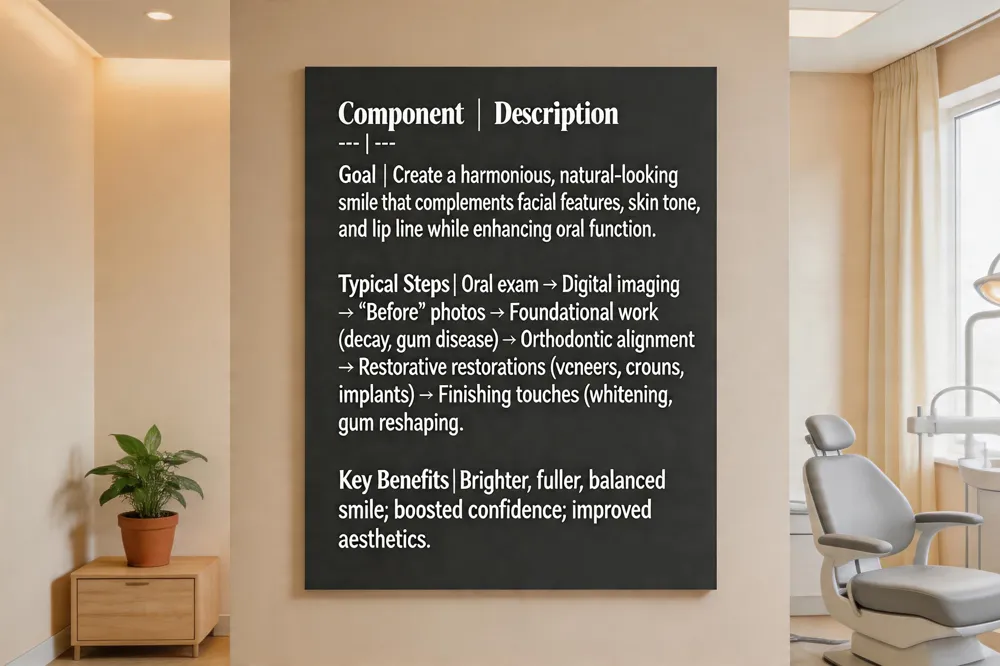
| Component | Description |
|---|---|
| Goal | Create a harmonious, natural‑looking smile that complements facial features, skin tone, and lip line while enhancing oral function. |
| Typical Steps | Oral exam → Digital imaging → "Before" photos → Foundational work (decay, gum disease) → Orthodontic alignment → Restorative restorations (veneers, crowns, implants) → Finishing touches (whitening, gum reshaping). |
| Key Benefits | Brighter, fuller, balanced smile; boosted confidence; improved aesthetics. |
 A smile makeover is a personalized, cosmetic‑dentistry treatment plan designed to improve the overall appearance of your smile. It blends one or more procedures—such as whitening, porcelain veneers, composite bonding, crowns, dental implants, clear‑aligner therapy (e.g., Invisalign®), gum contouring, or teeth contouring to address common concerns like discoloration, chips, gaps, misalignment, missing teeth, or a gummy smile.
Key aesthetic goals focus on creating a harmonious, natural‑looking smile that complements facial features, skin tone, and lip line while also enhancing oral function. The plan typically starts with a thorough oral examination, digital imaging, and “before” photographs to document the current state of teeth and gums. From there, a customized treatment sequence is developed, often beginning with foundational work (e.g., treating decay, gum disease) before moving to orthodontic alignment, restorative restorations (veneers, crowns, implants), and final polishing such as whitening or gum reshaping.
The result is a dramatically brighter, fuller, and more balanced smile that instantly boosts confidence and facial aesthetics, as illustrated by before‑and‑after images captured throughout the process.
Cost Overview of Smile Makeovers
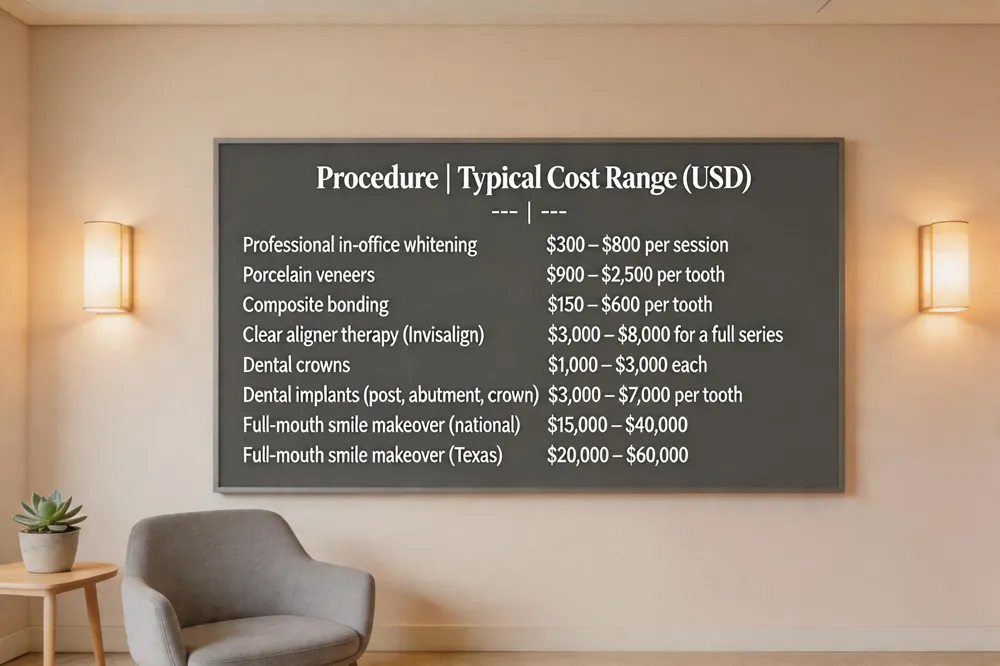
| Procedure | Typical Cost Range (USD) |
|---|---|
| Professional in‑office whitening | $300 – $800 per session |
| Porcelain veneers | $900 – $2,500 per tooth |
| Composite bonding | $150 – $600 per tooth |
| Clear aligner therapy (Invisalign) | $3,000 – $8,000 for a full series |
| Dental crowns | $1,000 – $3,000 each |
| Dental implants (post, abutment, crown) | $3,000 – $7,000 per tooth |
| Full‑mouth smile makeover (national) | $15,000 – $40,000 |
| Full‑mouth smile makeover (Texas) | $20,000 – $60,000 |
 A smile makeover brings together whitening, veneers, crowns, implants, gum contouring, and orthodontics to transform a smile. National and Texas price ranges – Across the United States, a full smile makeover typically falls between $15,000 and $40,000, while many patients report the overall $$,000‑$60,000** for comprehensive reconstructions. In Texas, prices are often a touch lower than the national average, with a full‑mouth smile makeover ranging from $20,000 to $60,000 depending on case complexity.
Factors that influence total cost – The final bill depends on the number of teeth treated, the materials selected (porcelain vs. composite), laboratory fees, and the technology used (digital smile design, CAD/CAM, 3‑D imaging). Additional considerations include whether orthodontic alignment (clear aligners or braces) is required, the need for gum contouring, and any underlying restorative work such as crowns or implants. Geographic location, dentist expertise, and whether financing (CareCredit®, in‑house plans) is utilized also affect the out‑of‑pocket amount.
Typical pricing for common procedures – Professional in‑office whitening runs $300‑$800 per session. Porcelain veneers cost $900‑$2,500 per tooth; composite bonding $150‑$600 per tooth. Clear aligner therapy (Invisalign) averages $3,000‑$8,000 for a full series. Dental crowns are $1,000‑$3,000 each, and implants (post, abutment, crown) range $3,000‑$7,000 per tooth.
Frequently asked questions
- Full smile makeover cost – $15,000‑$40,000 nationally; slightly lower in Texas.
- Smile makeover cost near me – In Midland, TX, options range $3,000‑$15,000 depending on procedures.
- Full smile makeover near me – Dr. Ashley E. Burns, DDS offers a personalized program combining veneers, implants, crowns, gum recontouring, and whitening.
- How much does a full smile makeover cost? – Typically $20,000‑$60,000.
- Smile makeover cost – From a few hundred dollars for whitening/bonding to $15,000‑$40,000+ for full‑mouth reconstruction.
- Smile makeover near me – Dr. Ashley E. Burns, DDS in Midland, TX provides comprehensive cosmetic dentistry.
- Smile makeover results near me – Patients experience natural‑looking, lasting results through a blend of whitening, veneers, bonding, and Invisalign®.
Veneers, Bonding, and Longevity
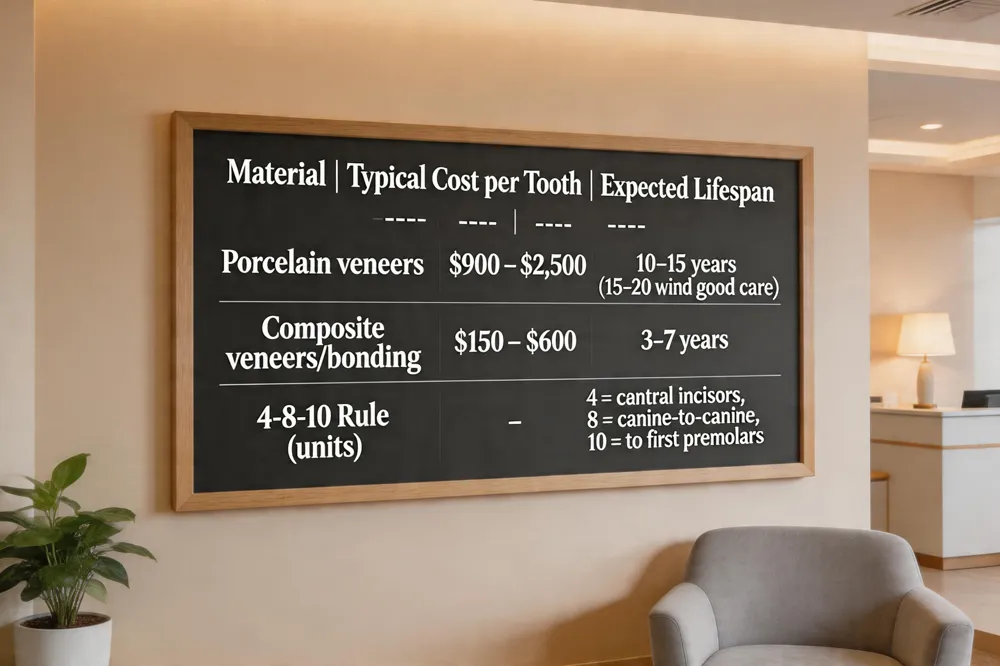
| Material | Typical Cost per Tooth | Expected Lifespan |
|---|---|---|
| Porcelain veneers | $900 – $2,500 | 10–15 years (often 15–20 years with good care) |
| Composite veneers/bonding | $150 – $600 | 3–7 years |
| 4‑8‑10 Rule (units) | – | 4 = central incisors, 8 = canine‑to‑canine, 10 = to first premolars |
 Porcelain veneers are ultra‑thin, custom‑crafted shells that bond to the front of the teeth, instantly correcting discoloration, chips, gaps, or slight misalignment as part of a full smile makeover. They are made of high‑strength dental porcelain, are stain‑resistant, and typically last 10–15 years—often 15–20 years or more with diligent oral hygiene. Composite veneers, by contrast, use a tooth‑colored resin that can be placed in a single visit and is far more budget‑friendly, but they generally last only 3–7 years and are more prone to staining.
A useful planning tool is the 4‑8‑10 rule. Four veneers cover just the central incisors, eight extend from canine to canine, and ten reach the first premolars, giving the dentist a quick estimate of how many units a patient may need for a broader, symmetrical smile.
What happens after 20 years of veneers? Over two decades the gum tissue may recede, exposing a darker line where the thin porcelain meets the natural enamel. The bond can weaken, leading to slight chipping, staining, or marginal leakage. Patients often notice a need for replacement or refinements at this stage.
Veneers before and after transformations are dramatic: worn, discolored, or uneven teeth become a bright, uniform, and natural‑looking set, boosting self‑esteem and confidence. In a comprehensive smile makeover, porcelain veneers serve as the centerpiece, delivering long‑lasting aesthetic improvement when combined with proper maintenance and periodic check‑ups.
Orthodontic Solutions: Aligners and Braces
| Treatment | Cost Range (USD) | Typical Duration |
|---|---|---|
| Clear aligners (e.g., Invisalign) | $3,500 – $8,000 | 6–12 months |
| Traditional metal braces | $4,000 – $7,500 | 12–24 months |
| Ceramic braces | $4,500 – $8,000 | 12–24 months |
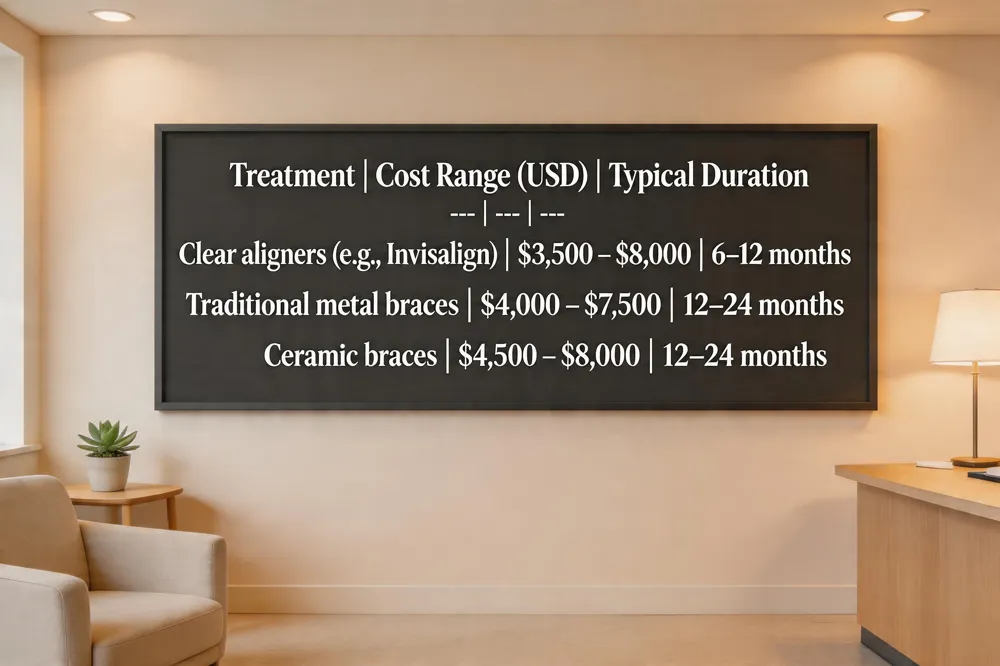 Clear aligner therapy, most commonly known by the brand name Invisalign®, offers a discreet, removable option for correcting mild to moderate malocclusion, crowded teeth, gaps, overbites, underbites, and crossbites. Treatment typically lasts 6–12 months, with patients wearing a series of custom‑fabricated trays that gently shift teeth into their ideal positions. Traditional braces—whether metal or ceramic—provide a fixed solution that can address more complex cases, but they are more visible and require periodic adjustments at the dental office. Both approaches are integral to a comprehensive smile makeover because they establish proper tooth alignment before restorative work such as veneers, crowns, or bonding is placed, ensuring a harmonious, lasting result.
Bad teeth before and after braces Before orthodontic treatment, “bad teeth” often appear crowded, crooked, or misaligned, creating gaps, overlapping edges, and an uneven bite. After a course of braces—whether traditional metal brackets, clear ceramic options, or Invisalign® aligners—the teeth are gradually shifted into proper alignment, closing gaps and eliminating overlaps. This foundational correction enhances the aesthetic impact of subsequent cosmetic procedures and improves overall oral function.
Clear aligners generally cost $3,500–$8,000 for a full series and are slightly shorter in duration than comprehensive metal braces, which range from $4,000–$7,500 and may require 12–24 months of treatment. Both options can be financed through CareCredit®, in‑house payment plans, or health spending accounts, making them accessible for patients seeking a smile makeover.
Dental Implants and Restorative Options
| Procedure | Cost Range (USD) | Key Considerations |
|---|---|---|
| Implant placement (post only) | $1,500 – $3,000 | Requires sufficient bone; may need grafting |
| Implant with crown | $3,000 – $7,000 per tooth | Includes post, abutment, crown |
| Bone grafting / sinus lift | $500 – $2,500 per site | Needed when jawbone volume is insufficient |
| Dental crowns (non‑implant) | $1,000 – $3,000 each | Material choice (porcelain vs. metal) |
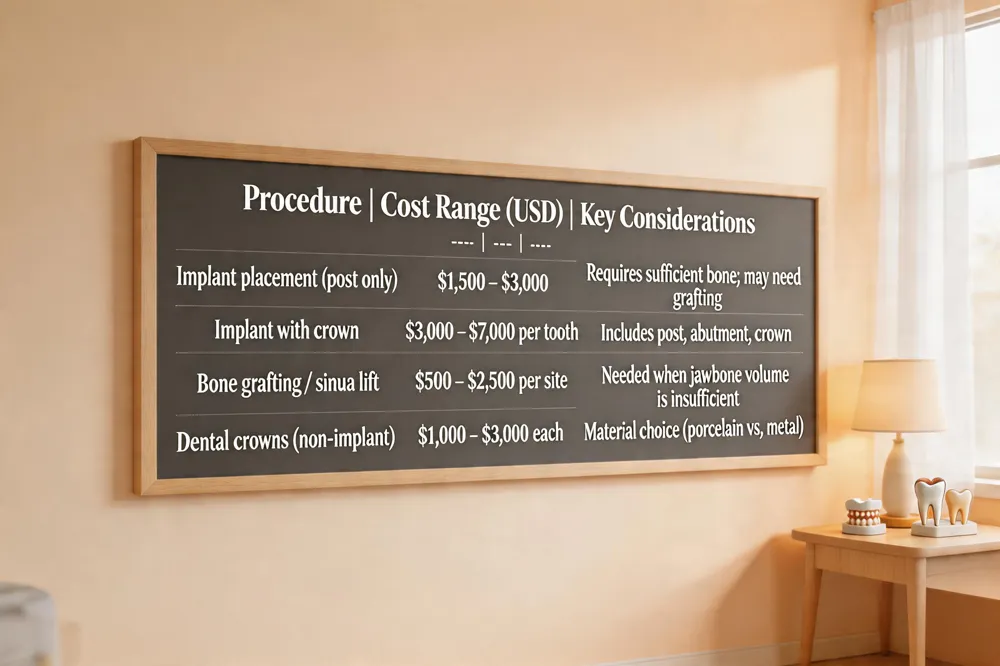 Implant surgery begins with a thorough oral examination and digital imaging to assess bone density and gum health. A titanium post is placed into the jawbone, where it undergoes osseointegration—a natural process where bone cells grow around the implant, creating a stable root‑like foundation for a crown, bridge, or denture. Healing can take 3‑6 months, during which the implant fuses securely to the bone.
If the jawbone is insufficient, bone grafting or sinus lift procedures are performed before placement. Grafting uses autograft, allograft, or synthetic material to rebuild volume, ensuring long‑term stability and reducing the risk of implant failure.
Patient considerations include overall health, smoking status, and any systemic conditions. Autoimmune diseases such as lupus may increase inflammation, potentially complicating healing and osseointegration; a detailed medical history helps the dentist tailor the plan.
Dental implants are titanium posts surgically placed into the jawbone to act as the roots of missing teeth, providing a stable foundation for crowns, bridges, or dentures.
Can a person with lupus get dental implants? Some studies link autoimmune diseases to a higher risk of implant failure because chronic inflammation can hinder gum healing and bone integration.
What I wish I knew before dental implants? I wish I had known that the implant process is a multi‑step journey that can take several months, because the bone needs time to integrate before the final restoration can be placed.
Financing, Community Giveaways, and Free Options
| Financing Option | Details |
|---|---|
| CareCredit® | Dental‑specific credit line; often 0% intro APR |
| Proceed Finance | Fixed‑payment plans with interest options |
| In‑house interest‑free plans | Directly arranged with practice; 0% for 6–12 months |
| HSA / FSA | Pre‑tax funds can be used for eligible procedures |
| Community contests (e.g., Village Dental “It Takes a Village”) | Winners receive reduced‑cost or complimentary makeovers |
| Charitable partnerships | Non‑profits may cover full cost for qualifying patients |
 When you’re ready for a Smile makeover, flexible financing can make the investment more manageable. Major dental credit providers such as CareCredit®, Proceed Finance, United Credit, iCreditWorks, and ALPHAEON are accepted by most practices, and many offices also offer in‑house interest‑free payment plans or Health‑Savings‑Account (HSA) and Flexible‑Spending‑Account (FSA) options. In addition to financing, local contests and promotions give patients a chance at a reduced‑cost or even complimentary makeover. While a national "smile makeover contest" is rare, many Texas dentists run community‑focused giveaways—think Village Dental’s “It Takes a Village” program or Angel Arches’ annual smile contests. In 2026, Dr. Ashley Burns, DDS will host a Smile Makeover Contest, inviting participants to share their stories and photos for a chance to receive a free, customized transformation. If you’re seeking a free smile makeover near you, ask your office about any charitable partnerships or nonprofit initiatives that provide complimentary cosmetic care to qualifying patients.
Maintenance, Oral Hygiene, and Longevity
| Practice | Frequency / Details |
|---|---|
| 3‑3‑3 brushing rule | Brush 3×/day, 3 minutes each, replace brush every 3 months |
| Flossing | Daily, preferably before bedtime |
| Dental check‑ups | Every 6 months (cleaning + exam) |
| Avoid staining foods/drinks | Limit coffee, red wine, tobacco; rinse after consumption |
| Routine polishing (veneers/crowns) | Every 1–2 years as needed |
| Implant maintenance | Same as natural teeth; regular professional cleanings |
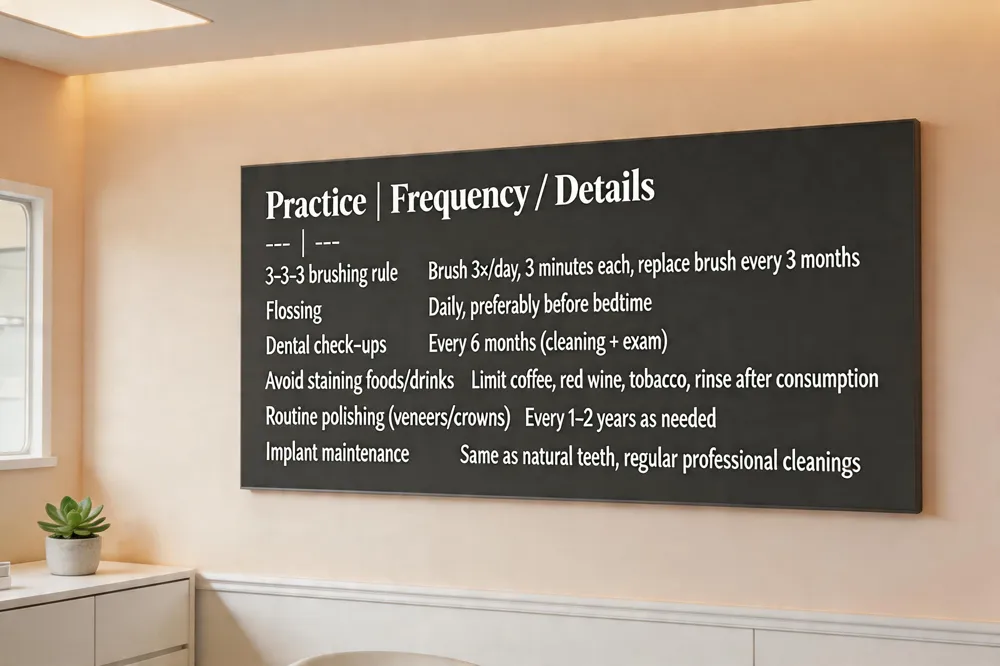 A successful smile makeover depends on diligent daily care and smart lifestyle choices. Daily brushing and the 3‑3‑3 rule – brush three times a day (after breakfast, after lunch, and before bed), for three minutes each session, and replace the toothbrush every three months – helps keep restorations like porcelain veneers, crowns, and implants free of plaque and stains. Foods that naturally brighten teeth include strawberries, whose malic acid gently lifts surface discoloration, as well as crunchy raw vegetables such as apples and carrots that act as natural toothbrushes. Expected lifespan of a makeover varies by material; porcelain veneers and crowns typically last 10‑15 years, composite bonding 5‑7 years, while implants can endure a lifetime with proper hygiene. In general, most comprehensive makeovers remain aesthetically pleasing for 5‑15 years, with diligent oral hygiene extending results even further.
Fun Fact and Media Spotlight
| Celebrity | Procedure(s) Used | Notable Fact |
|---|---|---|
| Donald Trump | Full‑mouth porcelain veneers | Gives a uniformly white appearance; often misattributed to perfect hygiene |
| Hollywood actors (various) | Whitenings, veneers, Invisalign | Frequently share before‑after journeys boosting public interest |
| Midland, TX – Dr. Ashley E. Burns, DDS | Comprehensive smile makeover (veneers, implants, crowns, gum recontouring, whitening) | Offers personalized programs and community contests |
 Celebrity smile myths capture the public’s imagination, especially when a star’s dazzling grin becomes a talking point. One of the most popular rumors involves former President Donald Trump, whose teeth are often described as "perfectly shaped" and "a fanciful shade of white." In reality, Trump’s bright, uniform smile is not the result of a rigorous oral‑hygiene routine; it is achieved with custom‑made porcelain veneers that cover his natural teeth, giving them a flawless, white appearance. This example illustrates how veneers and crowns can transform a smile and why many public figures turn to cosmetic dentistry for aesthetic confidence. Beyond politics, Hollywood actors, musicians, and athletes frequently share their smile makeover journeys—ranging from simple whitening to full‑arch veneer sets—sparking interest in the latest dental technologies such as digital smile design and gum contouring. These stories remind patients that a radiant smile is attainable with personalized, professional care.
Take the First Step Toward Your New Smile
The journey to a radiant, confident smile begins with a free, no‑obligation consultation at Dr. Burns’ office. During this initial visit, Dr. Burns conducts a comprehensive oral examination, uses digital imaging and 3‑D smile design software to assess your teeth, gums, bite and facial structure, and discusses your aesthetic goals. The findings are then compiled into a personalized treatment plan that outlines the recommended procedures—whether it’s professional whitening, porcelain veneers, Invisalign clear aligners, gum contouring or implants—and provides a clear timeline. To make the investment manageable, the office offers a range of financing options, including interest‑free in‑house payment plans, CareCredit® and other dental credit providers, as well as the ability to use Health Savings (HSA) or Flexible Spending Accounts (FSA). By reviewing both the treatment roadmap and the flexible payment solutions, you can move forward with confidence, knowing exactly what to expect and how to budget for your new smile.